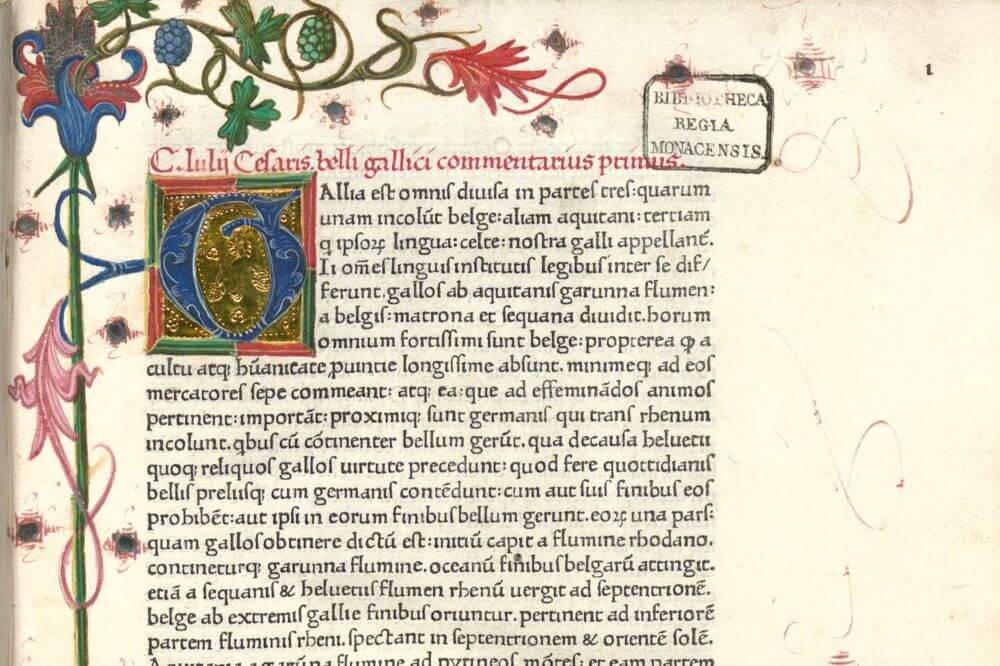
Gallia est omnis divisa in tres partes. If you have been to grammar school, you will undoubtedly recognize this line as the beginning of Caesar’s Comentarii de Bello Gallico. While it is famously hated by students of Latin for its repetitive and unadorned nature, this very fact simultaneously makes it an excellent primer for beginner-level students of Latin. I too am currently reading it, in my case of my own volition in order to brush up on my Latin, so I decided to read up on its historic background so that it may add to my reading experience. The Gallic Wars were waged between 58 and 50 BC by Julius Caesar, the up and coming general who rapidly emerged as one of the rising men of power in ancient Rome. And it so happens that his reports are the only contemporary literary source we have on the Gallic Wars, so one should approach his work with some suspicion.
“The Gallic War is perhaps not altogether a straightforward account of events. Moreover, certain matters – the part played by personal ambition in determining Caesar’s course of action, and the large personal fortunes that he and some of his associated made from his conquest – are discreetly unmentioned while he sometimes seems to dissimulate his real intentions to conceal their relative failure. (…) However, even if a judicious subtraction is made for possible distortion of his own and other’s motives, the body of fact that is left is invaluable. The Gallic War is our only direct narrative actually written by a great general of antiquity about his own campaigns.”
Jane F. Gardner, from the Introduction of S.A. Hanford’s translation of the Gallic War
As a rising politician who had spent a lot of money to become a consul in 59 BC, Caesar had burdened himself with a enormous debt. Assigned as the proconsul of two provinces, Illyricum and Cisalpine Gaul for five rather than one year, Caesar made full use of his position to enrich himself by means of conquest and plunder. A mass migration of Helvetii into Gaul then provided him with a convenient casus belli. Caesar quickly gathered his troops and began to prepare for war.
The Gallic Wars
The Helvetians: A Campaign in the East
As the word spread that the Helvetians, a Celtic tribe from the area of modern-day Switzerland, were migrating into Gaul, neighbouring tribes were grew worried. The Helvetians had burned their villages and crops, so they would be more motivated to pursue their road westward now they knew they had no homes to return to anymore. They firstly requested the Romans for permission to cross the province of Transalpine Gaul, but Caesar refused. When they turned northwards instead, crossing the borders of some Gallic allies of Rome, these tribes then asked the Romans for help, for the Helvetians were ravaging their lands. Or that is at least what Caesar wants us to believe, for in every mentioned conflict he always presents the other party as the aggressor. Either the other party did not agree with the demands set by Caesar, or some allies of Rome asked him to defend them against a hostile invader.
“Unable to defend their persons and their property from the invaders, the Aedui sent deputies to Caesar to ask for aid. These pleaded that the Aedui had always deserved too well of the Roman people to merit the devastation of their lands, the removal of their children into slavery, and the capture of their towns, almost in sight of the Roman army. At the same time the Ambarri, close allies and kinsmen of the Aedui, informed Caesar that their lands had been laid waste, and that they could not easily safeguard their towns from the violence of the enemy. The Allobroges also, who had villages and settlements across the Rhone, fleet to Caesar, affirming that they had nothing left to them save the bare ground. All these events drove Caesar to the decision that he must not wait till the Helvetii, having wasted all the substance of the Roman allies, should penetrate into the land of the Santoni.”
Caesar, De Bello Gallico 1.11 (trans. H.J. Edwards)
Caesar thus tried to legitimize his declarations of war. It is a textbook example of Caesar presenting himself as a diplomat rather than a warmonger, as some of his actions might suggest. For at the Battle of Bibracte, he would massacre the Helvetians in a manner that modern historians have described as genocide. Caesar himself claims to have killed and captured up to 238,000 Helvetians.

Crossing the Channel: The Invasion of Britain
After subduing a large part of Gaul, including the Germanic Suebi and the the Belgic Nervii in the North-East and the Veneti in the North-West, Caesar launched an invasion of Britian in 55 BC. Likely urged by political rather than strategic concerns, because with the consuls Pompey and Crassus as competitors he had to stay in the public eye, he did something that no Roman had ever attempted before. He crossed the English Channel, from Dover to Kent, and launched an invasion of Britannia. But when he attempted to land, the Britons were waiting for him, including their cavalry and characteristic Celtic chariots. Caesar tried moving up the coast, but the opposing force was no less imposing there. Struggling to disembark and hesitant to engage on such unequal ground, it was only after a great act of courage of the Tenth Legion’s standard bearer that the tides would turn. The first to jump into the water, he encouraged his fellow soldiers to follow suit, which they did, for it was a great humiliation for the Romans to lose their eagle (aquila) in battle.
“So [the Britains] sent forward their cavalry and charioteers — an arm which it is their regular custom to employ in fights — and, following up with the rest of their forces, they sought to prevent our troops from disembarking. (…) [But] then, while our troops still hung back, chiefly on account of the depth of the sea, the eagle-bearer of the Tenth Legion, after a prayer to heaven to bless the legion by his act, cried: “Leap down, soldiers, unless you wish to betray your eagle to the enemy; it shall be told that I at any rate did my duty to my country and my general.” When he had said this with a loud voice, he cast himself forth from the ship, and began to bear the eagle against the enemy. Then our troops exhorted one another not to allow so dire a disgrace, and leapt down from the ship with one accord. And when the troops on the nearest ships saw them, they likewise followed on, and drew near to the enemy.”
Caesar, De Bello Gallico 4.24-25 (trans. H.J. Edwards)

The Romans eventually prevailed over the Britons but could not chase their enemies down, because the cavalry had failed to make the crossing. Nonetheless, the expedition was a great success, for when he returned to Rome, Caesar was hailed as a hero and was given an unprecedented twenty-day thanksgiving. The next year, on his second invasion of Britain, Caesar finally succeeded to get a foothold in the south of Britannia. He triumphed over king Cassivellaunus and exacted payments of grain, slaves, and an annual tribute to Rome.
The Gallic Revolt: Ambiorix and Vercingetorix
While Caesar had been away, some Gallic tribes had started to revolt. Harvests had failed in Gaul, but Caesar still demanded the local tribes to supply the troops stationed there for the winter with food. Ambiorix, the leader of the Eburones, tricked one of the Roman legates called Sabinus into thinking that all of Gaul was now revolting. Sabinus believed him and was promised a safe passage.
“No, there was common consent among the Gauls: this was the day appointed for assaulting all the cantonments of Caesar, so that one legion might not be able to come to the support of another. It would not have been easy for Gauls to refuse Gauls, especially when they considered that the design they had entered on was for the recovery of their common freedom. (…) Having satisfied the Gauls as far as the claim of his country required, he had regard to his duty in response to the good offices of Caesar; and he warned, he prayed Titurius, as in private duty bound, to take measures for his own and his soldiers’ safety. (…) He promised them, and confirmed it with an oath, that he would grant them safe passage through his borders.”
Caesar, De Bello Gallico 5.27 (trans. H.J. Edwards)
But at the moment he left his camp, he and his troops were ambushed and slaughtered. When the other tribes in Gaul heard the news, they too joined the cause of a rebellion against the Romans.

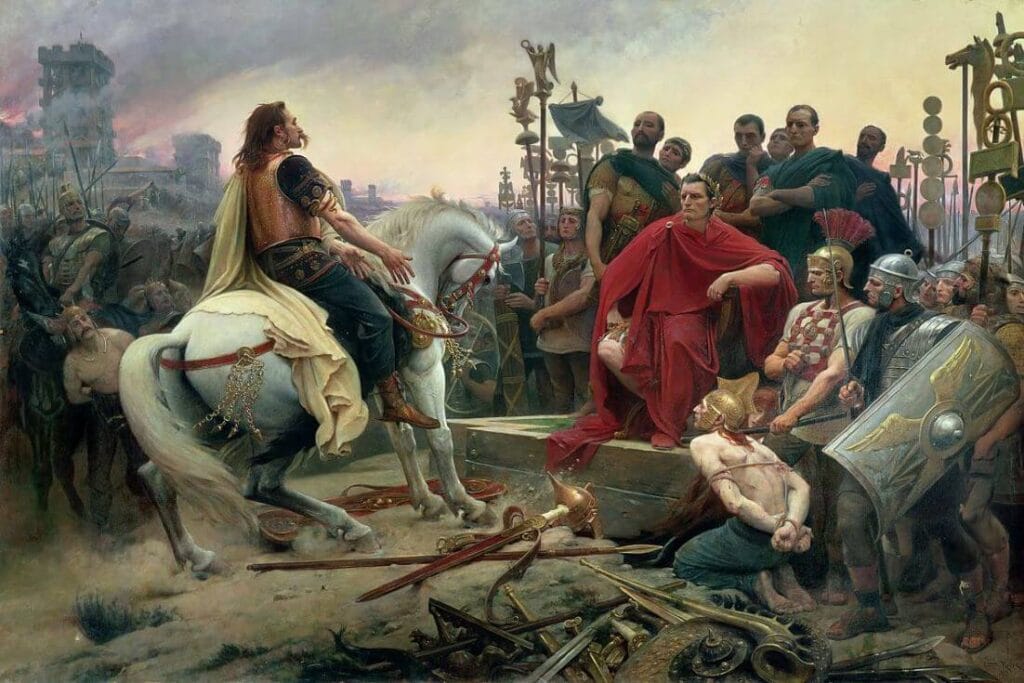
That winter of 54 BC would become a disaster for Caesar. He would lose a whole legion with another almost destroyed. Caesar had to act quickly and decided to attack both civilian and military targets in order to demoralize the tribes. But instead of subduing them, he saw the Gauls more than ever united in their commons cause: to liberate themselves from oppression by the Romans, who now treated them as if they were a Roman province, instating Roman religion, customs, and laws. United under the charismatic king of the Averni tribe, Vercingetorix, they formed an unprecedented coalition of Gallic tribes. Under his leadership, they even defeated the Romans once in a head-on confrontation, at the battle of Gerovia, but eventually he too had to concede. At the battle of Alesia, the Gauls were finaly defeated. Caesar besieged the town and was able to starve out his opponents. Vercingetorix was forced to surrender. Plutarch recounts this moment in dramatic fashion, with the Avernian king throwing himself at Caesar’s feet.
“Those who held Alesia, too, after giving themselves and Caesar no small trouble, finally surrendered. And the leader of the whole war, Vergentorix, after putting on his most beautiful armour and decorating his horse, rode out through the gate. He made a circuit around Caesar, who remained seated, and then leaped down from his horse, stripped off his suit of armour, and seating himself at Caesar’s feet remained motionless, until he was delivered up to be kept in custody for the triumph.”
Plutarch, Caesar 27.8-10 (trans. Bernadotte Perrin)
The conquest of Gaul had given Caesar the wealth and authority that enabled him to wage a civil war with his fellow Romans, famously crossing the symbolic Rubicon when marching on Rome. Caesar won the civil war against Pompey and the senate and declared himself dictator for life, something that would at last lead to the end of the Roman Republic. His adoptive son Octavianus would become the first emperor of Rome, marking the beginning of the Roman Empire. In other words, it was the conquest of Gaul that made Caesar prosperous, popular, and powerful enough steer the course of history, shaping a world in which not the senate but one man ruled almighty.
Further Reading
In this article I have highlighted some of the extraordinary events of the Gallic Wars. If you would like to read Caesar’s complete commentaries, which form virtually our own contemporary source of the Gallic Wars, then I can recommend you the translation by H.J. Edward’s, which I also used for this article. If you are interested in Caesar himself, it might be rewarding to read Plutarch’s Life of Caesar, where he is paired together with his Greek counterpart and role model Alexander the Great. If you, like me, would like to brush up on your Latin, I can wholeheartedly recommend the Geoffrey Steadman edition for beginners and the Hans Ørberg edition for intermediate students of Latin. The latter is from Ørberg’s wonderful Lingua Latina Per Se Illustrata (LLPSI) series, a widely used method for learning Latin through the ‘natural method’.