Have you ever wondered where Europe got its name from? Look no further, for today I will discuss the myth of the Phoenician princess Europa, to whom the continent of Europe owes its name. Now, in the canon of Greco-Roman mythology, we find two opposing account of this story. On the one hand, Herodotus tells that Europa was abducted by Greeks who sought to avenge the abduction of the Argive princess Io. Ovid, on the other hand, in his Metamorphoses recounts a more well-known version of the story, one in which Europa was abducted by Zeus in the form of a bull. When Zeus was looking down from Mount Olypmus, he spotted the Tyrian princess and her entourage gathering flowers near the shore; he was instantly consumed by a fiery passion for her.
“The cattle were driven from the mountain and headed for the shore, as Jove had directed, to a spot where the great king’s daughter was accustomed to play in company with her Tyrian maidens. Majesty and love do not go well together, nor tarry long in the same dwelling-place. And so the father and ruler of the gods, who wields in his right hand the three-forked lightning, whose nod shakes the world, laid aside his royal majesty along with his sceptre, and took upon him the form of a bull. In this form he mingled with the cattle, lowed like the rest, and wandered around, beautiful to behold, on the young grass.”
Ovid, Metamorphoses 2.843-851 (trans. Frank Justus Miller)
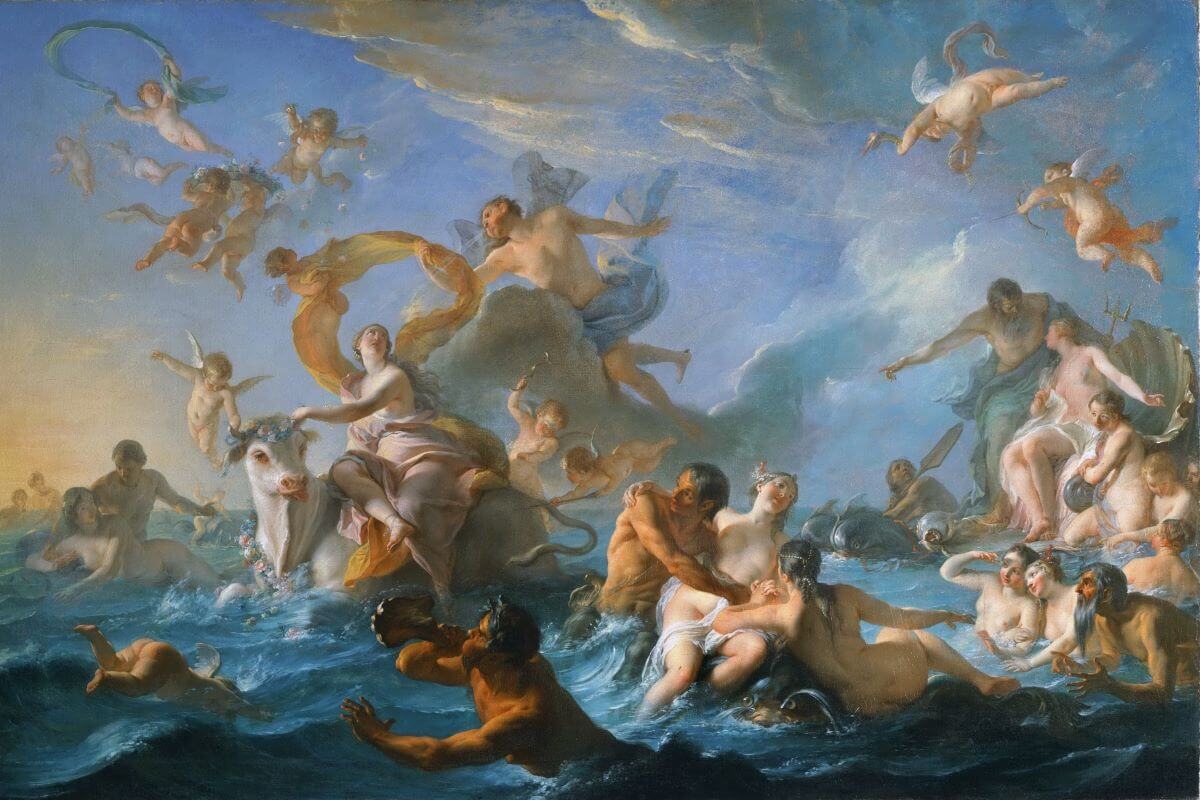
White as the untrodden snow, with rounded muscles, and with horns perfect as if carved by an artist’s hand, the bull – into which Zeus was transformed – was quite a sight to behold. Even though it appeared gentle, with a peaceful brow, Europa at first was a bit hesitant to approach him. At last, however, she dared to come nearer, holding out her flower to his snow-white lips. When Zeus had eventually won her trust, the princess even dared to sit upon his back, not knowing that she was in the presence of a god. Zeus had waited for this moment all along, and he gradually began sneaking away from the servants, slowly approaching the shore until he could rush off at full speed.
“The god little by little edges away from the dry land, and sets his borrowed hoofs in the shallow water; then he goes further out and soon is in full flight with his prize on the open ocean. She trembles with fear and looks back at the receding shore, holding fast a horn with one hand and resting the other on the creature’s back. And her fluttering garments stream behind her in the wind.”
Ovid, Metamorphoses 2.870-875 (trans. Frank Justus Miller)
Zeus swam across the sea until he reached the island of Crete, his place of birth. After Zeus revealed his true identity, Europa could not resist his advances. Europa gave birth to Minos, Rhadamanthus – who would become the judges of the underworld – and Sarpedon, and she herself would become the first queen of Crete.

Analysis
There are a couple of aspects of the myth that are noteworthy. Firstly, the myth of Europa is one of many myths that are based on Zeus’ affairs, often following a fixed structure: Zeus falls in love with a mortal woman, he transforms himself into an animal so that he can approach her without suspicion, after which Hera enters the stage as a jealous wife to punish these women, even though they are themselves the victims of Zeus’ love. It shows that the oral tradition that preceded the mythological canon, as with the Iliad, gave way to many versions of the same story, like variations on a theme. Secondly, it has been suggested that the myth may reflect the historical colonization of the Mediterranean by the Phoenicians. The idea is that the Phoenicians were looking for the Tyrian princess after her abducation and thus migrated and settled down throughout the Mediterranean. Thirdly, Europa ever since is associated with the continent to which she was carried by Zeus, because she gave it its name: Europe. Today, her countenance can still be seen by every European resident , for she is stamped on the reverse side of the Greek €2-coin.