Marguerite Yourcenar (1903-1987) was a Belgian-French novelist and essayist, best known for her Memoirs of Hadrian. Born in Brussels, into a wealthy family of noble descent, Marguerite enjoyed a privileged upbringing. Living at the family estate, she was home-schooled in modern languages and Latin by her father. When he died, his inheritance enabled her to live a nomadic and independent life. By then, she had adopted the pen-name Yourcenar, an anagram of her birth name ‘Crayencour’. She would spend most of her life working on the Memoirs of Hadrian, her most notable work.

(Wikimedia Commons)
“In turning the pages of a volume of Flaubert’s correspondence much read and heavily underscored by me about the year 1927 I came gain upon this admirable sentence: ‘Just when the gods had ceased to be, and the Christ had not yet come, there was a unique moment in history, between Cicero and Marcus Aurelius, when man stood alone.’ A great part of my life was going to be spent in trying to define, and then to portray, that man existing alone and yet closely bound with all being.”
Marguerite Yourcenar, Reflections on the Composition of Memoirs of Hadrian (trans. Grace Frick)
In the Memoirs of Hadrian, Yourcenar tried to create a vivid and historically accurate portrait of the 2nd-century Roman world from the perspective of its ruler, the emperor Hadrian. It is astounding how this 20th-century novelist has disclosed this distant world of the past, from its inhabitants, customs, and religions to the military campaigns, the political intrigues, and life at the imperial court. She wanted to portray Hadrian and his contemporaries in a vivid manner, as people of flesh and blood, endeavoring ‘to restore the mobility and suppleness of life to those visages known to us only in stone.’ For if we really want to know them, Yourcenar implies, we have to see them as human beings like you and me rather than those austere and enigmatic figures of the past.
“Keep one’s own shadow out of the picture; leave the mirror clean of the mist of one’s breath; take only what is most essential and durable in us, in the emotions aroused by the sense or in the operations of the mind, as our point of contact with those men who, like us, nibbled olives and drank wine, or gummed their fingers with honey, who fought bitter winds and blinding rain, or in summer sought the plane tree’s shade; who took their pleasures, thought their own thoughts, grew old, and died.”
Marguerite Yourcenar, Reflections on the Composition of Memoirs of Hadrian (trans. Grace Frick)
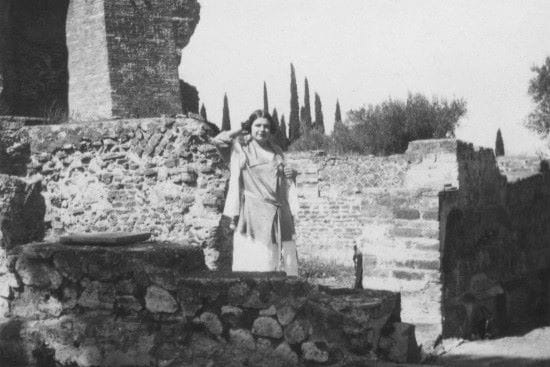
Although Yourcenar was not a classicist, she read all the source material available in her time, which included the works of ancient historians, surviving correspondences, and inscriptions. When there was a lack of evidence or documentation, she convincingly filled those gaps by using her historically informed imagination which her studies and countless travels in Hadrian’s footsteps allowed her.
“Mornings spent at the Villa Adriana; innumerable evenings passed in small cafés around the Olympieion; the constant back and forth over Greek seas; roads of Asia Minor. In order to make full use of these memories of mine they had first to recede as far from me as is the Second Century.”
Marguerite Yourcenar, Reflections on the Composition of Memoirs of Hadrian (trans. Grace Frick)
Memoirs of Hadrian

(Wikimedia Commons)
The Memoirs of Hadrian is a fictionalized autobiography of the 2nd-century emperor Hadrian. It is written in the first person singular and addressed at his adoptive grandson Marcus Aurelius, who Hadrian envisioned to become his successor after Antoninus Pius. Residing at his villa complex near Rome, he begins to reflect on his life and his career as an emperor, so that Marcus may learn from it and, as he says, ‘to at the very last know myself better before I die.’
“Little by little this letter, begun in order to tell you of the progress of my illness, has become the diversion of a man who no longer has the energy required for continued application to affairs of state; it has become, in fact, the written meditation of a sick man who holds audience with his memories. I propose now to do more than this: I have formed a project for telling you about my life.”

Hadrian gives a roughly chronological account of his life, starting with his early years. He recounts his upbringing in the rural township of Italica, southern Spain, how he underwent his preliminary training in the Seventh Legion, and how he eventually was sent to Rome to be educated in the matters of grammar and rhetoric. Gradually shifting to matters of state, Hadrian introduces us to matters of politics, telling how he eventually rose to power and became emperor of Rome. He had at that point already earned his spurs, but emperor Trajan had long refused to appoint a successor.
“I was awakened in the middle of the night by arrival of a messenger; at once I recognized a confidential envoy of [the empress] Plotina. He brought two missives. (…) [The] second letter, this one secret, told me of [Trajan’s] death, which Plotina promised to keep hidden as long as possible, thus giving me the advantage of being the first one warned. (…) Everything that for ten years’ time had been feverishly dreamed of, schemed, discussed or kept silent, was here reduced to a message of two lines, traced in Greek in a small, firm, feminine hand. Attianus, who awaited me on the pier of Selinus, was the first to salute me with the title of emperor.”

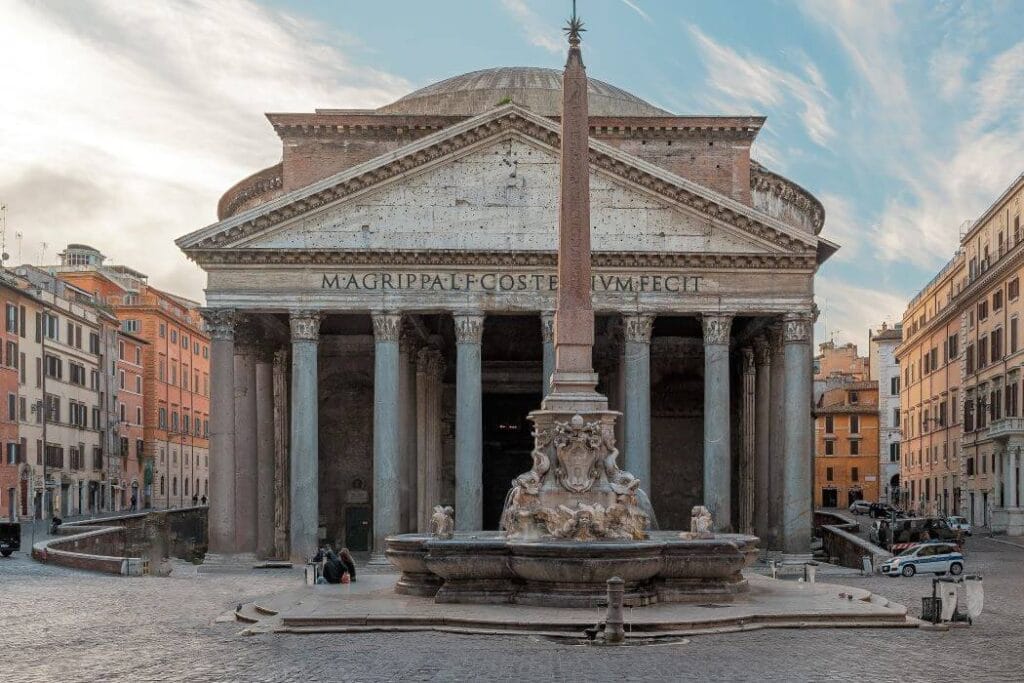
Once in power, Hadrian attempted to establish stability throughout the empire, which he promoted with the triad Humanitas, Libertas, Felicitas (‘Civilisation, Freedom, Happiness’). He tried to curb the military expansion and rather envisioned to consolidate the territory of the empire, a policy that was especially exemplified by the building of Hadrian’s Wall in Britannia. Other than economic and military reforms, he also commissioned countless building projects, like the Pantheon, the Temple of Venus and Rome, and the Temple of Olympian Zeus in Athens. By building these lasting structures, Hadrian wished to rule from beyond the grave, bestowing upon future generations these places of gathering, worship, and beauty that would far outlive himself.
“Our life is brief: we are always referring to centuries which precede or follow our own as if they were totally alien to us, but I have come close to them in my play with stone. These walls which I reinforce are still warm from contact with vanished bodies; hands yet unborn will caress the shafts of these columns. The more I have meditated upon my death, and especially upon that of another, the more I have tried to add to our lives these virtually indestructible extensions.”
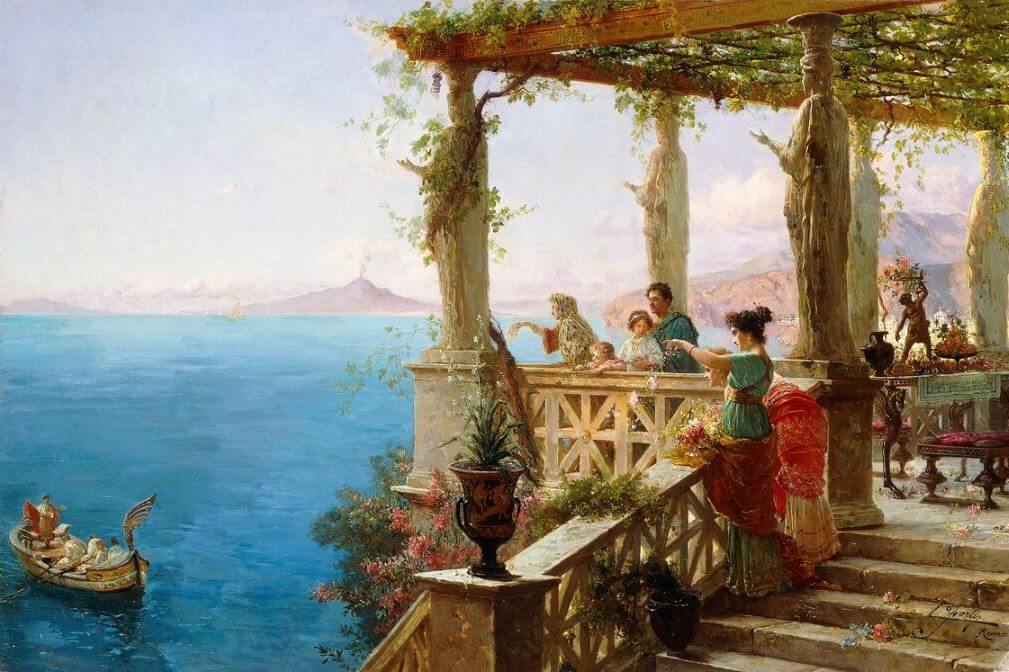
Hadrian repeatedly stresses that it was his wish to consolidate the period of peace established by Augustus, known as the Pax Romana. Yourcenar portrays Hadrian as a visionary and idealist emperor, who wished not only to infuse the empire with the cardinal virtues of reason, justice, and moderation, but also with beauty, as the poetry of his own words fittingly reflect.
“I wanted the cities to be splendid, spacious and airy, their streets sprayed with clean water, their inhabitants all human beings whose bodies were neither degraded by marks of misery and servitude nor bloated by vulgar riches; I desired that the schoolboys should recite correctly some useful lessons; that the women presiding in their households should move with maternal dignity, expressing both vigor and calm; that the gymnasiums should be sued by youths not unversed in arts and in sports; that the orchards should bear the finest fruits and the fields the richest harvests. I desired that the might and majesty of the Roman Peace should extend to all, insensibly present like the music of the revolving skies; that the most humble traveller might wander from one country, or one continent, to another without vexatious formalities, and without danger, assured everywhere a minimum of legal protection and culture; that our soldiers should continue their eternal pyrrhic dance on the frontiers; that everything should go smoothly, whether workshops or temples; that the sea should be furrowed by brave ships, and the roads resounding to frequent carriages.”
While Hadrian liked to present himself as a just and restrained emperor, he was also envious, excessive, and hedonistic. This is best displayed in his unrestrained love for Antinous, a young man from Claudiopolis, modern-day Turkey. Antinous would later accompany the emperor on all of his travels, showing that the emperor was not immune to sensual pleasure and passionate desire. When this young man tragically died on one of Hadrian’s journeys over the Nile, purportedly by suicide, the emperor was inconsolable, so much so that he honoured his lover in the most excessive and lavish manner possible: he deified Antinous and founded a cult devoted to his worship. But it becomes clear that Hadrian himself had always worshipped Antinous, even when he was still alive.
“On a journey to Troas we visited the plain of the Scamander in time of catastrophe. (…) I took a moment to pay homage at the tomb of Hector; Antinous stood dreaming over Patroclus’ grave but I failed to recognize in the devoted young fawn who accompanied me an emulator of Achilles’ friend. (…) I have seen the boy anxious at the thought of soon becoming nineteen. Dangerous whims and sudden anger shaking the Medusa-like curls above that stubborn brow alternated with a melancholy which was close to stupor, and with a gentleness more and more broken. Once I struck him; I shall remember forever those horrified eyes. But the offended idol remained an idol, and my expiatory sacrifices began.”

Antinous’ death instilled in Hadrian a kind of melancholy that would never truly leave him. During his final years in Tibur, Hadrian began reflecting on his life while gradually handing over matters of state. He had by now fallen ill and sleeping had become a nightmare. Plagued by ill health, he had briefly considered suicide. But once he had appointed and adopted his designated successors, Antoninus followed by Marcus Aurelius, he had come to terms with his end. Happy to be in some way reunited with his lover Antinous, he was resolved to enter death with open eyes.
“Little soul, gentle and drifting, guest and companion of my body, now you will dwell below in pallid places, stark and bare; there you will abandon your play of yore. But one moment still, let us gaze together on these familiar shores, on these objects which doubtless we shall not see again. Let us try, if we can, to enter into death with open eyes…”

Conclusion
With this book, the Belgian-French Marguerite Yourcenar has written a work for the ages, to paraphrase Thucydides. These Memoirs of Hadrian are written with a poetic opulence that seem to have sprung from the mellifluent verses of Homer himself, told with such conviction that it makes you believe it is the emperor himself speaking to you. It is an incredible achievement of writing, research, and imagination how convincingly she filled the gaps of uncertainty in such a manner that you cannot distinguish between fact and fiction. In these memoirs, Hadrian speaks to us as if he were still alive today. It is as if the past coincides with the present, and as if the gap between then and now has suddenly closed – if only for a brief moment.
“Experiments with time: eighteen days, eighteen months, eighteen years, or eighteen centuries. The motionless survival of statues which, like the head of the Mondragone Antinous in the Louvre, are still living in a past time, a time that has died. The problem of time foreshortened in terms of human generations: some five and twenty aged men, their withered hands interlinked to form a chain, would be enough to establish an unbroken contact between Hadrian and ourselves.”
Marguerite Yourcenar, Reflections on the Composition of Memoirs of Hadrian (trans. Grace Frick)