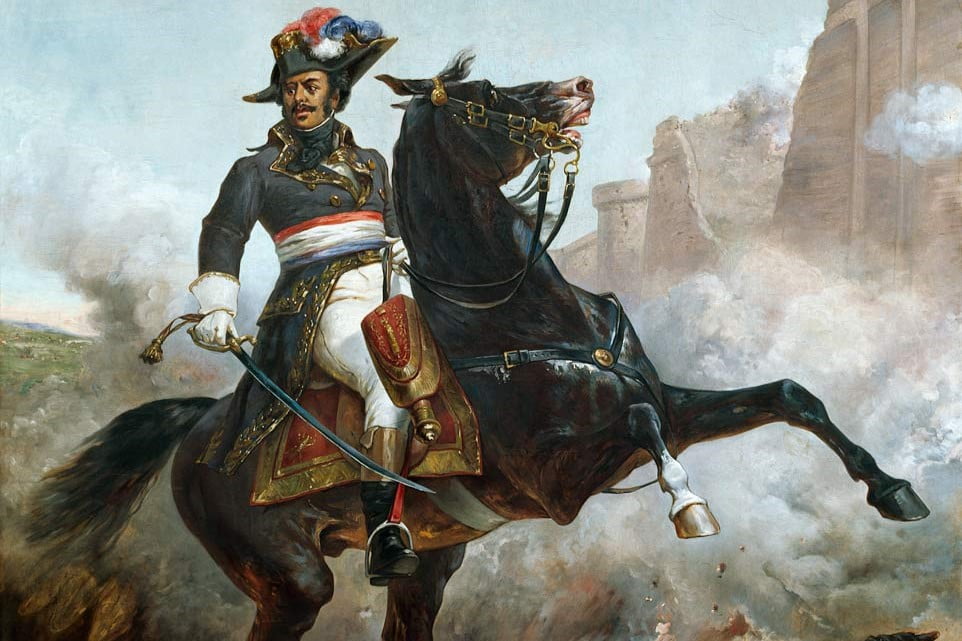
Alexandre Dumas (1802-1870) was a French novelist and playwright, mostly known for his historical novels such as The Three Musketeers and The Count of Monte Cristo. Dumas was born in Villers-Cotterêts in northern France, as the son of a French general in Napoleon’s army. After his father died, his mother was struggling to make ends meet and the family lived in relative poverty. Nonetheless, as a bright young man, Dumas was able to learn quickly. After briefly working as a local clerk, he moved to Paris in 1822, where he would soon pursue a literary career. He started out writing plays in the romantic style, which were a major success and eventually allowed him become a full-time writer. He was one of the most prolific writers of his day, publishing over 600 plays, novels, travel books, and memoirs. However, he depended in part on assistant writers to achieve such a high literary output.
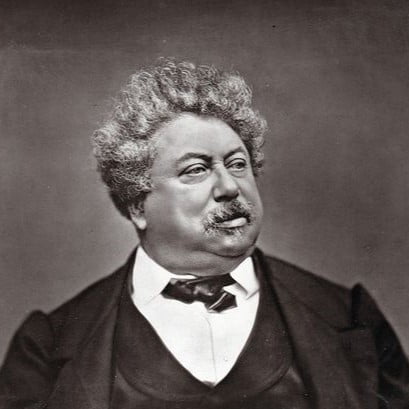
(Wikimedia Commons)
“Early in his career, comments were made about his use of collaborators, and even friends and fellow authors found it hard to believe that any one man could, unaided, write or even dictate all the vast novels he signed. In 1845 a journalist named Émile de Mirecourt attempted to expose Dumas, accusing him of directing a ‘fiction-factory’ which employed writers to turn out the serials and volumes to which he put his signature. Dumas took him to court and won the case.”
David Coward, from the introduction of his translation of The Count of Monte Cristo
Despite the assistance of such ‘ghost-writers’, there is no doubt that Dumas was ultimately responsible for the final tone, tension, and form of the narrative. You could compare the practice to that of the old masters who merely sketched out the initial design and added the finishing touches, while leaving the majority of the work to the studio assistants. Of his numerous works, Dumas would attain the greatest success with his serials, novels that were published in smaller, sequential instalments in the newspaper. The Count of Monte Cristo, for example, was originally published in 139 instalments in the French newspaper Journal des débats. Not only did it allow for the novel to reach a wider audience, but every episode filled with drama and suspense left the reader wanting for more, making it the talk of the town for two years until the story was finally concluded.
The Count of Monte Cristo
Background
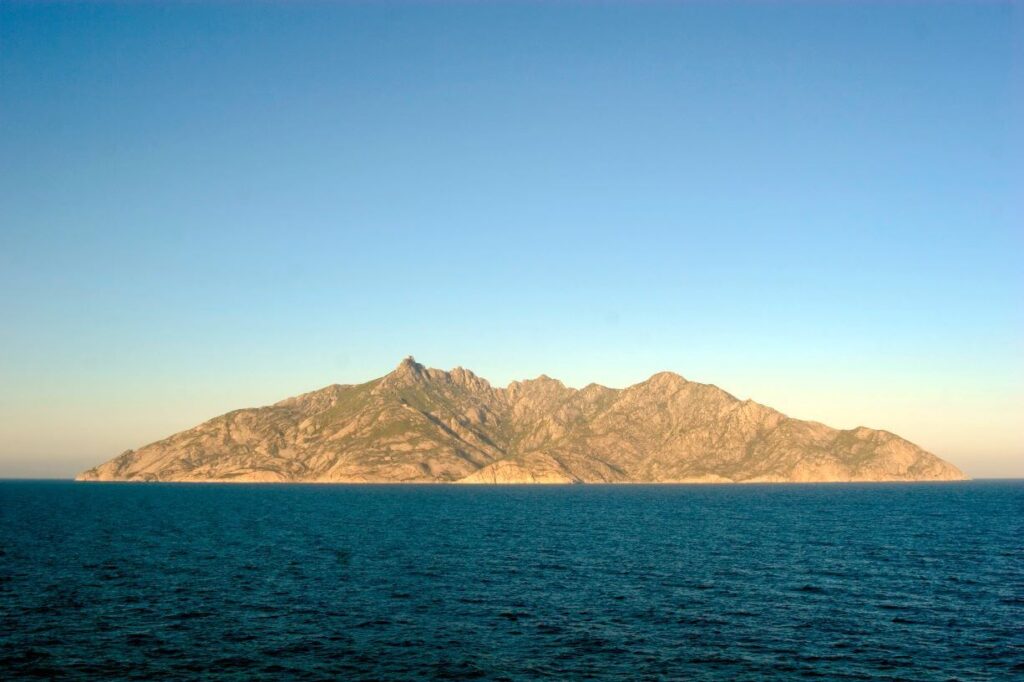
Alexandre Dumas was inspired to write The Count of Monte Cristo by one of his trips in Italy. When he lived in Florence in 1841, Dumas had close contacts with members of the Bonaparte family. On one of his trips, he travelled to the small Island of Monte Cristo, between Corsica and Italy, next to Elba. There, he promised Louis Bonaparte’s cousin, who accompanied him on the journey, that he would write a novel bearing island’s name. And so it came to pass.
List of Characters

(Wikimedia Commons)
- Edmond Dantès: the hero of our story – a promising, handsome young sailor, later also known as ‘The Count of Monte Cristo’
- Mercédès: Dantès’ fiancée, who later marries Fernand after Dantès is imprisoned
- Abbé Faria: the Italian priest in prison, who reveals the secret of Monte Cristo’s treasure
- Fernand Mondengo: the young man who plots against Dantès and later marries Mercédès
- Gaspard Caderousse: the neighbour of Dantès father, who was complicit to Fernand’s schemes
- Monsieur Danglars: a crewmate of Dantès who is jealous and conspires against him
- Monsieur de Villefort: the prosecutor who sentences Edmond to save his own skin
Summary of The Count of Monte Cristo
1. Imprisonment
The Count of Monte Cristo tells the story of Edmond Dantès. At the beginning of the book, he is a promising, handsome young sailor who is about to be promoted to captain and to marry the love of his life, Mercédès. However, when three jealous men conspire against him, his luck is about to turn. What should have been the best day of his life soon turns into a nightmare. To make matters worse, his prosecutor is more worried about his own position than about Edmond. On the basis of false charges, he is arrested on his wedding day and imprisoned on the infamous prison island of Chateau d’If. There, in the deepest dungeon, secluded of any contact, he abandons all hope.
“I have lost all that bound me to life; death smiles and invites me to repose; I die after my own manner, I die exhausted and broken-spirited, as I fall asleep when I have paced three thousand times round my cell.”
The Count of Monte Cristo, Chapter 15, ‘Number 34 and number 27’ (trans. David Coward)

2. The Escape
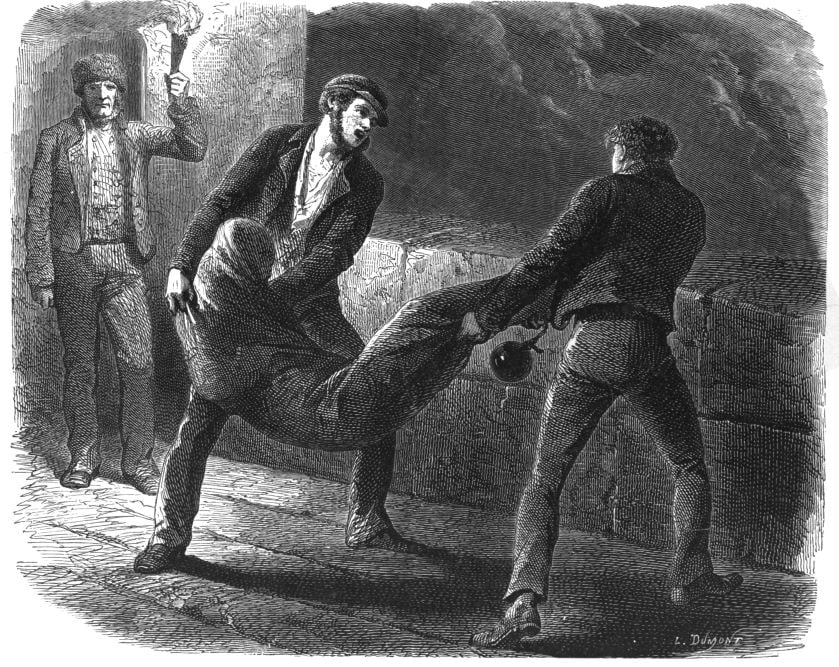
One day Edmond meets another prisoner, named Abbé Faria, an Italian priest and intellectual, who dug an escape tunnel that happened to end in his cell. From his new friend, Edmond learns that he has been betrayed by four people: Fernand, Danglars, Caderousse, and Villefort. They all had their own reasons for conspiring against him: Fernand loved Mercédès, Danglard wanted to become captain himself, Caderousse was an envious neighbour, and Villefort feared that Edmond had information that could endanger his position. Edmond then vows that he will do everything in his power to avenge his conspirators, should he ever get free. When Abbé Faria is on the verge of dying, he tells Edmond of a secret treasure on the island of Monte Cristo. Soon after, Faria died and Edmond made use of the occasion to escape: he took is friend’s place in the burial sack, gets thrown in the sea, cuts open the sack and swims to a nearby island.
3. The Treasure
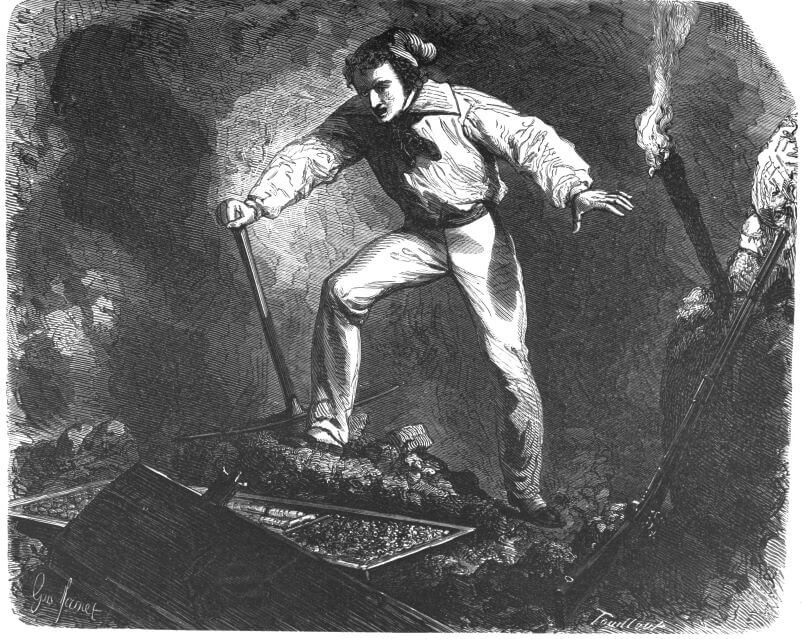
After swimming to the island, Edmond is picked up by a ship of smugglers, who take him to Italy. It allows him to visit the island of Monte Cristo. There, after following the strict instructions of his late friend Abbé Faria, Edmond eventually finds the great treasure. Again the tides have turned, and Edmond is a rich man. From now on, he names himself ‘The Count of Monte Cristo’ and he resolves to use all this wealth to reward those who have helped him and to avenge those who had betrayed them and who made him rot away in prison for no less than fourteen years.
4. Taking Revenge
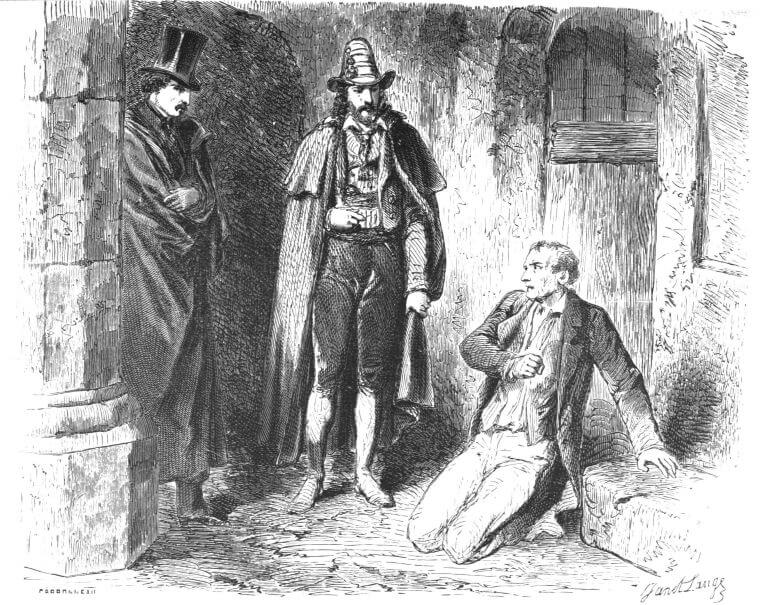
The rest of the novels tells how Edmond Dantès meticulously prepares and executes his revenge. Firstly, he allows Caderousse to be murdered, after he deemed that Caderousse had not bettered himself after countless opportunities. Secondly, he punishes Fernand, who had married his fiancée, Mercédès. Monte Cristo, as he is now known, leaks information that shows that Fernand is a traitor. After he also ruined Fernand’s family ties by telling Mercédès that it was Fernand who fabricated the false charges against him. Now rejected by society and his own family, Fernand resorts to suicide and shoots himself. Thirdly, Monte Cristo takes revenge on Villefort by slowly revealing compromising information about the prosecutor, such as his secret affair and his illegimate child. He then allows Villefort’s wife, who knew about the affair, to poison all family members. Monte Cristo eventually reveals his true identity to Villefort, driving him insane. Fourthly, he punishes the avaricious Danglars by ruining him financially. Though, after Danglars finally repents, Dantès forgives him and lets him depart unscathed.
5. A Final Farewell
Having exacted revenge on his wrongdoers, Monte Cristo does one last thing before leaving. As a last act of goodwill, he unites the lovers Maximilien Morrel and Valentine Villefort, whose union was strictly forbidden by Valentine’s parents. Having finally found peace, he allowed himself to fall in love with the beautiful Haydée, who had just declared her love to him. They set sail and left the island, never to be seen again. Only his last letter to Maximilien is left, which reads as follows.
“There is neither happiness nor misery in the world; there is only the comparison of one state with another, nothing more. He who has felt the deepest grief is best able to experience supreme happiness. We must have felt what it is to die, Morrel, before we can appreciate the enjoyments of life. Live, then, and be happy, beloved children of my heart, and never forget, that until the day when God deigns to reveal the future to man, all human wisdom is contained in these two words, ‘Wait and hope.’
Your friend, Edmund Dantès, Count of Monte Cristo”
The Count of Monte Cristo, Chapter 117, ‘The Fifth of October’ (trans. David Coward)

Conclusion
Reading Dumas’ The Count of Monte Cristo was an incredibly satisfying experience. Rarely have I been so glued to a book, which I took with me wherever I went. Since it is an adventure novel, you cannot really compare it to literature like Dostoyevski’s Crime and Punishment. This compelling story of revenge is as engrossing as it is absurd. Despite many bizarre characterizations and plot turns, the story is totally engrossing. It is fascinating how Dumas makes use of suspense to evoke such feelings of admiration, disgust, and hate. It is as if you, the reader, are exacting vengeances on Edmond Dantès’ wrongdoers. And you feel purified and cleansed when it is done (cf. the idea of catharsis). It is, in short, a book I would not have missed for the world, a bit over the top, but all the more enchanting. Umberto Eco put it as follows – and I cannot but completely agree with him.
“The Count of Monte Cristo is one of the most exciting novels ever written. With one shot (or with a volley of shots, in a long-range bombardment), Dumas manages to pack into one novel three archetypal situations capable of tugging at the heartstrings of even an executioner: innocence betrayed, the persecuted victim’s acquisition—through a stroke of luck—of a colossal fortune that places him above common mortals, and finally, the strategy of a vendetta resulting in the death of characters that the novelist has desperately contrived to appear hateful beyond all reasonable limits.”
Umberto Eco, excerpted from On the Shoulder of Giants (trans. Alastair McEwen)