So often when we think about ancient Rome, we tend to think of its glorious history: a world of mighty emperors, illustrious generals, and lofty orators and poets. Add to this that almost all of our literary sources are from Rome’s ruling class, and you soon get a very distorted idea of what life must have been like for the ordinary Roman. Fortunately, there is a enough archaeological, epigraphic, and even some literary evidence that can give up a glimpse of daily life in ancient Rome. For example, where did they live, how did they spend their free time, and what did they eat? It is a part of Rome’s history that is often overlooked: the life of the ordinary Roman.
Housing
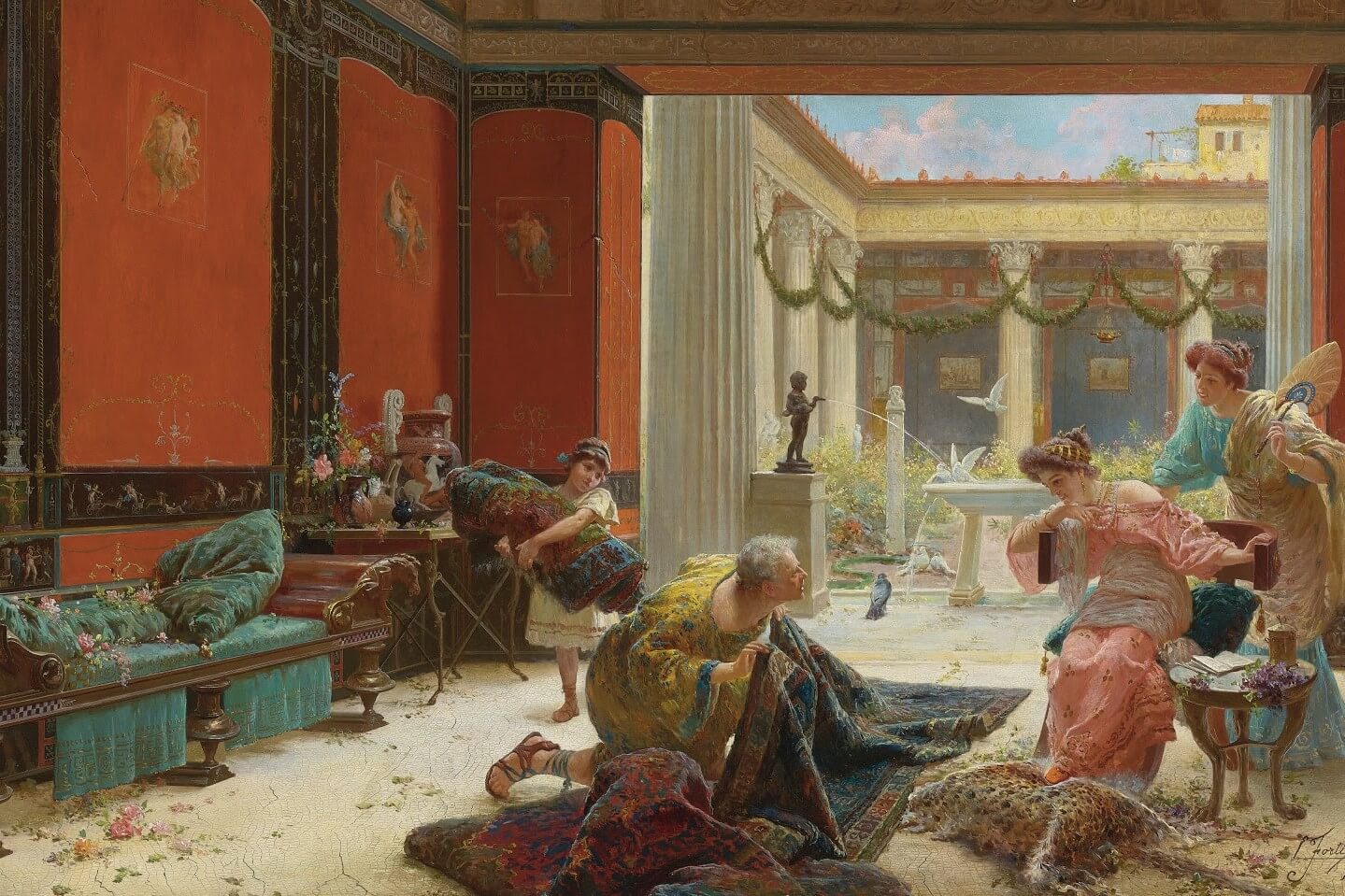
Rome’s upper class would have lived in a luxurious town house (domus), a free standing structure commonly containing an entryway (vestibulum), a central hall where guests were received and ceremonies were performed (atrium), and an inner courtyard with a portico (peristylium), surrounded by the dining room (triclinium), the kitchen (culina), and the bedrooms (cubicula). As if this was not enough, the wealthiest families would also have owned a country house (villa), for if they wanted to escape the busy city life. The ordinary Roman, however, would not have been able to afford such a comfortable dwelling. They would have lived in big, overcrowded, multistorey apartment blocks, which were known as insulae (‘islands’), because they were isolated building structures usually containing a whole city block. These buildings were often owned by rich Romans, like the famous orator Cicero, who were generally interested in little more than collecting the rent. The Roman poet Juvenal in his Satires mentions the deplorable state of such apartments.
“But here we inhabit a city supported for the most part by slender props: for that is how the bailiff patches up the cracks in the old wall, bidding the inmates sleep at ease under a roof ready to tumble around their ears. No, no, I must live where there are no fires, no nightly alarms.”
Juvenal, Satires 3.193-198 (trans. G.G. Ramsay)
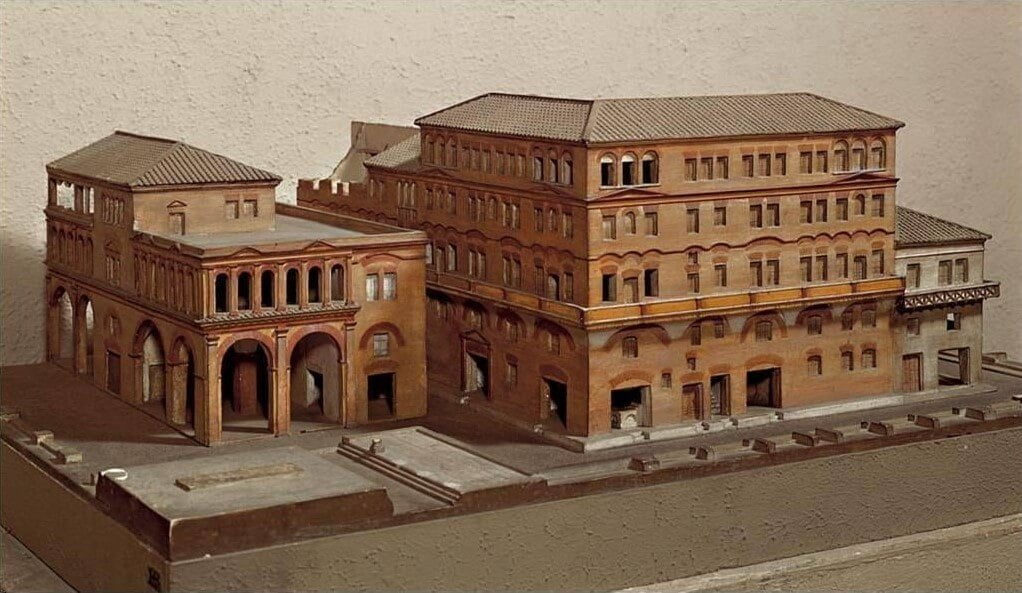
The lowest apartment housed the wealthiest tenants, who lived right above the shops that would have faced the streets (tabernae). The higher you climbed, the smaller the rooms, the fewer the comforts, and the poorer the people you encountered. You have to imagine that families were cramped together in single rooms with little to no furniture, with no access to running water, without a kitchen or a stove, and sometimes even without access to natural light. Therefore, these upper-level apartments were almost exclusively used to sleep in – if you could sleep at all, that is.
“Do you ask why I often visit my bit of land near dry Nomentum and my villa’s dingy hearth? Sparsus, there’s no place in Rome for a poor man to think or rest. Schoolmasters deny you life in the morning, bakers at night, the hammers of the coppersmiths all days.”
Martial, Epigrams 12.57 (trans. D.R. Shackleton Bailey)
Living Outdoors
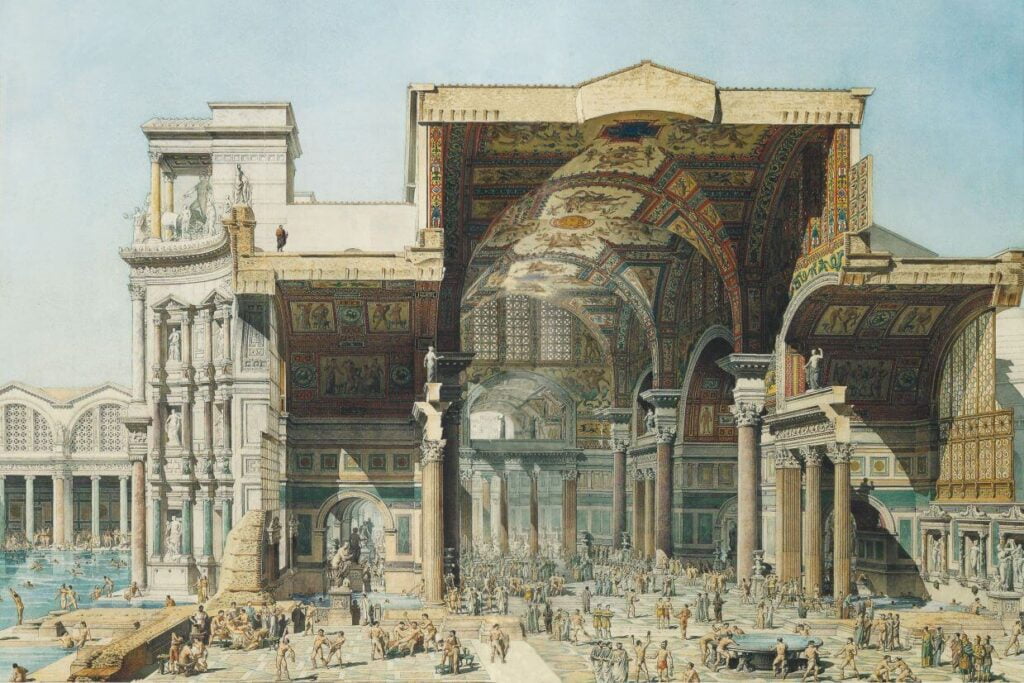
To eat, to bathe, or to relieve yourself, you would have had to go outside. Private life was only granted to the rich, insofar it existed at all. For most Romans, life happened outdoors: on the streetcorners, on the communal latrines, and in the public baths. These baths were not only important for the city’s health, but they were also an absolutely crucial part of the city’s social structure, which was why the emperors made a point out of making these facilities available to everyone. Accessible to all layers of society, with little to no entrance fee, they were places for exercise, relaxation, education, socializing, eating, and business. Whereas the smaller baths (balnea) served as community centres, the larger complexes (thermae) provided public services that were otherwise unavailable to the average Roman, such as baths, gyms, art galleries, and even libraries.
The streets of Rome were always bustling with activity, be it by the countless shops that lined the streets (tabernae), by pedestrians going their ways, by patrons followed by their clients, by noblemen carried in litters (lectica), or by transport of cattle and food supplies. Juvenal hated it all.
“When the rich man has a call of social duty, the mob makes way for him as he is borne swiftly over their heads in a huge Luburnian car. He writes or reads or sleeps as he goes along, for the closed window of the litter induces slumber. Yet he will arrive before us; hurry as we may, we are blocked by a surging crowd in front, and by a dense mass of people pressing in on us from behind: one man digs an elbow into me, another a sedan-pole; one bangs a beam, another a wine-cask, against my head. My legs as plastered with mud; huge feet trample on me from every side, and a soldier plants his hobnail firmly on my toe.”
Juvenal, Satires 3.239-248 (trans. G.G. Ramsay)
The noise of these heavy four-wheel carriages (raeda) was so deafening that they were by decree prohibited to enter the city by day, though at night they were said to made sleep impossible.
“Who but the wealthy get sleep in Rome? There lies the root of the disorder. The crossing of wagons in the narrow winding streets, the slanging of drovers when brought to a stand, would make slepe impossible for a Drusus – or a sea-calf.”
Juvenal, Satires 3.235-238 (trans. G.G. Ramsay)

The din of the streets might have been annoying when you were trying to sleep, but when you were out and about on the streets at night, noise would have been the least of your problems. Keep in mind that the alleys of Rome were narrow, dark, and dirty; most roads were unpaved, there was no street lighting, and there was no real law enforcement keeping an eye on you. And while Rome did have a legal system, it almost exclusively applied to the ruling class. So, especially at night, the streets of Rome were considered to be dangerous. In his Satires, Juvenal warns of the many perils of nocturnal Rome, including the danger of falling roof-tiles, broken pots, muggers, and burglars. While he might have said this in a joking fashion, there must surely have been some truth to it.
“And now regard the different and diverse perils of the night. See what a height it is to that towering roof from which a potsherd comes crack upon my head every time that some broken or leaky vessel is pitched out the window! See with what a smash it strikes and dints the pavement! There’s death in every open window as you pass along at night; you may well be deemed a fool, improvident of sudden accident, if you go out to dinner without having made your will. You can but hope, and put up a piteous prayer in your heart, that they may be content to pour down on you the contents of their slop-pails! (…) Such is the liberty of the poor man: having been pounded and cuffed into a jelly, he begs and prays to be allowed to return home with a few teeth in his head! Nor are these your only terrors. When your house is shut, when bar and chain have made fast your shop, and all is silent, you will be robbed by a burglar; or perhaps a cut-throat will do for you quickly with cold steel.”
Juvenal, Satires 3.268-305 (trans. G.G. Ramsay)
Family Life
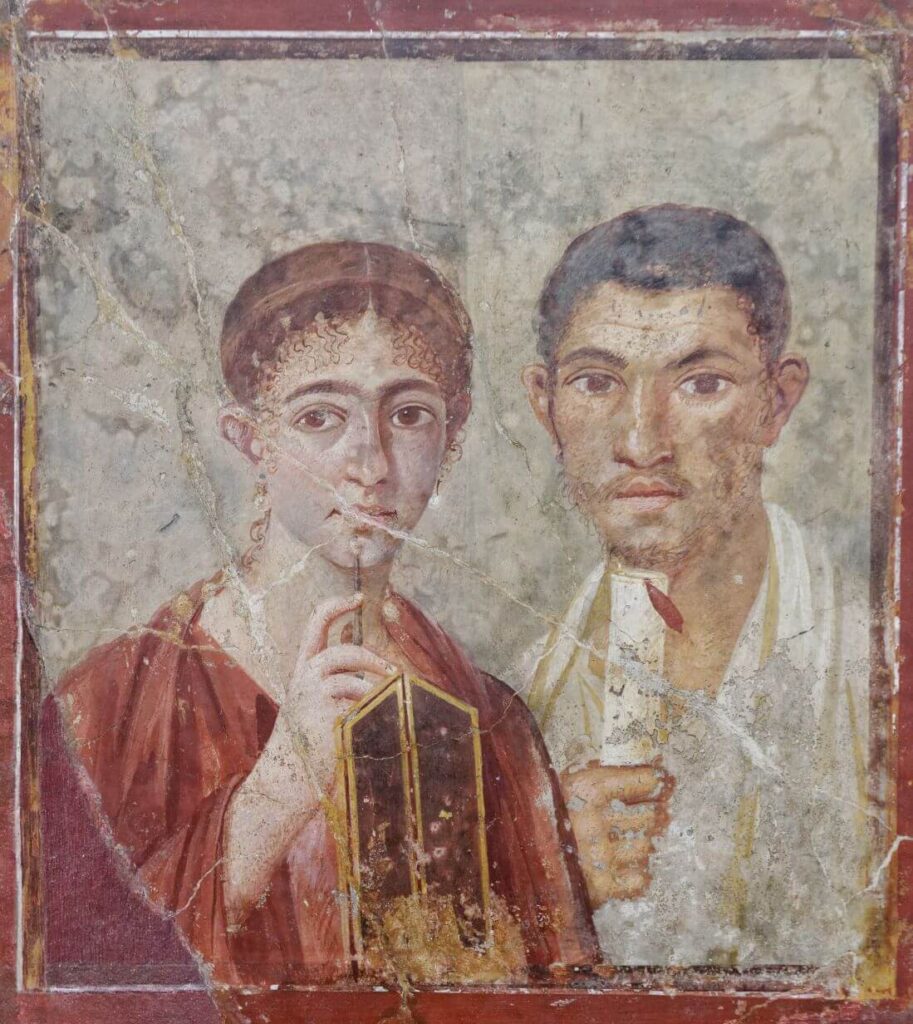
The master of the Roman family was the father, the pater familias, who had the power of life and death over all family members and slaves. You have to keep in mind that one in three persons in Augustan Rome would have been a slave, so even poorer families would have had one. They were often treated with cruelty, but some of them were able to buy their freedom eventually. Women were supposed to stay inside to protect their virtue and chastity, but they obtained more liberties towards the end of the republic. As for children, only wealthy families could afford education, so most children simply had to work from a very early age to support their family.
Work
Agriculture and land ownership formed the basis of the Roman economy, so a large majority of the Roman people would have worked as a farmer (agricola) in the countryside, cultivating wheat, olives, and whine. However, this was obviously different in urban Rome, where most people would have been wage labourers (mercenarii), doing day jobs in construction or in the supply of food (i.e. carrying around produce). If you were lucky enough to have a skill or some capital, you could have had the chance to pursue a profession. Many of Rome’s tombstones attest to the different jobs people had, mostly providing luxury items or services to the rich, from making clothes embedded with gold (aurivestrix) to being a wetnurse (nutrix). Many freedmen seem to have taken great pride in their work, for their profession is often depicted on their tombstones. Most aristocrats, on the other hand, scorned the idea of work (negotium). Sometimes they would pursue a career in law or politics, but they mostly spent their time between leisure (otium) and managing their wealth.

Leisure: Bread and Games
Since jobs required natural light, the workday usually ended around dawn. The evening, then, was a time for leisure. They would might take a bath in the public bathhouse, they might take a stroll, and they had some dinner. The average Roman would not have a lush dinner party (convivium) like aristocrats were used to. Since most Roman would even not have a kitchen, using their apartment only to sleep, they would grab a bite at one of Rome’s many bars (thermopolia), where ready-to-eat hot meals were served. The average diet was simple and consisted of grain (bread or porridge), olive oil, and wine, at times supplemented with fruits and vegetables. Fish and especially meat was rare and mostly reserved to the rich. Sometimes they used a fermented fish sauce (garum) to add some flavour. Like their diet, their leisure activities were also simple (panem et circenses). Though it has to be said that public entertainment provided by the state was reserved to a number of public holidays (feriae). The majority of entertainments were ludi: theatrical performances, dances, and chariot races. The munera, which included gladiatorial combats, wild animals shows, and other exhibitions, were very costly and thus extremely rare. To put it in perspective: there might have only been two to three gladiatorial games a year, whereas each of the over hundred public holiday would have included chariot races, with over twenty races a day. So every public holiday, the whole city would pour out to the races in the Circus Maximus, with everyone supporting and betting on their favourite teams (factiones): the Blues, Greens, Reds, and Whites, named after the colours worn by the charioteers (aurigae) – as we read in Juvenal.
“All Rome today is in the Circus. A roar strikes upon my ear which tells me that the Green has won; for had it lost, Rome would be as sad and dismayed as when the Consuls were vanquished in the dust of Cannae. Such sights are for the young, whom it befits to shout and make bold wagers with a smart damsel by their side.”
Juvenal, Satires 11.197-202 (trans. G.G. Ramsay)

Conclusion
To conclude, daily life in ancient Rome was difficult, dangerous, and very dynamic. While the rulers provided free access to public baths and organized public games, for many it must have been no more than a temporary relief from their daily struggles. And they would be lucky if, when going home, they did not get mugged or assaulted, for the streets were dangerous and you had to fend for yourself. The average Roman would have been a slave, an ex-slave, or a poor civilian struggling to get by. They would have been pressed to pay the rent for their creaky apartment blocks, where they had no running water and little to no furniture. Every day they would eat same: bread or porridge. We may marvel at Rome’s imposing monuments, its mighty rulers, and its revered poets, but we should remember that many did not share in Rome’s riches, but rather suffered to provide them. They too left their traces, and they ask us to remember them too, as in the following inscription on one of the many tombstones along the Appian Way, of the ex-slave and pearl-seller Euhodus.
“Stranger, stop and turn your gaze towards this hillock on your left, which holds the bones of a poor man of righteousness and mercy and love. Wayfarer, I ask you to do no harm to this memorial. Gaius Attilius Euhodus, freedman of Serranus, a pearl-merchant of Holy Way, is buried in this memorial. Wayfarer, good bye.”
Corpus Inscriptionum Latinarum I2 1212 (trans. E.H. Warmington)
Bibliography
Aldrete, G.S. (2004). Daily Life in the Roman City. Westport: Greenwood Press.
Carcopino, J. (2003). Daily Life in Ancient Rome. New Haven: Yale University Press.
Matz, D. (2002). Daily Life of the Ancient Romans. Westport: Greenwood Press.
Ramsay, G.G. (1928). Juvenal and Persius. Satires. Cambridge: Harvard University Press.
Shackleton Bailey, D.R. (1993). Martial. Epigrams. Cambridge: Harvard University Press.
Warmington, E.H. (1940). Remains of Old Latin, Vol. IV. Cambridge: Harvard University Press.