Hercules, known as Heracles in Greek, was the greatest of the Greek heroes. He was famous for his incredible strength and especially for performing the so-called Twelve Labours. Born as the son of Zeus and Alcmene, his divine parentage gave him great powers. However, his ancestry also proved to be a great burden, for the jealous Hera did everything in her power to bring her husband’s bastard son to ruin. She even tried to kill Hercules when he was just an infant, but to no avail.
“When the child was eight months old, Hera desired the destruction of the babe and sent two huge serpents to the bed. Alcmena called Amphitryon to her help, but Hercules arose and killed the serpents by strangling them with both his hands.”

Hera knew that she was unable to kill Hercules and so she resorted to other ways of tormenting him. After Hercules had married the Theban princess Megara and had three sons with her, Hera made him lose his mind. In a state of madness and insanity, he killed his own wife and children. When he came back to his senses and realized what he had done, Hercules could not forgive himself and condemned himself to exile. In desperate need of counsel, he went to the Oracle of Delphi, where the priestess told Hercules he could redeem himself and atone for his crimes by serving Eurystheus, king of Mycenae, for twelve years and by performing a set of labours for him.
First Labour: Nemean Lion
“First, Eurystheus ordered him to bring the skin of the Nemean lion; now that was an invulnerable beast begotten by Typhon.”
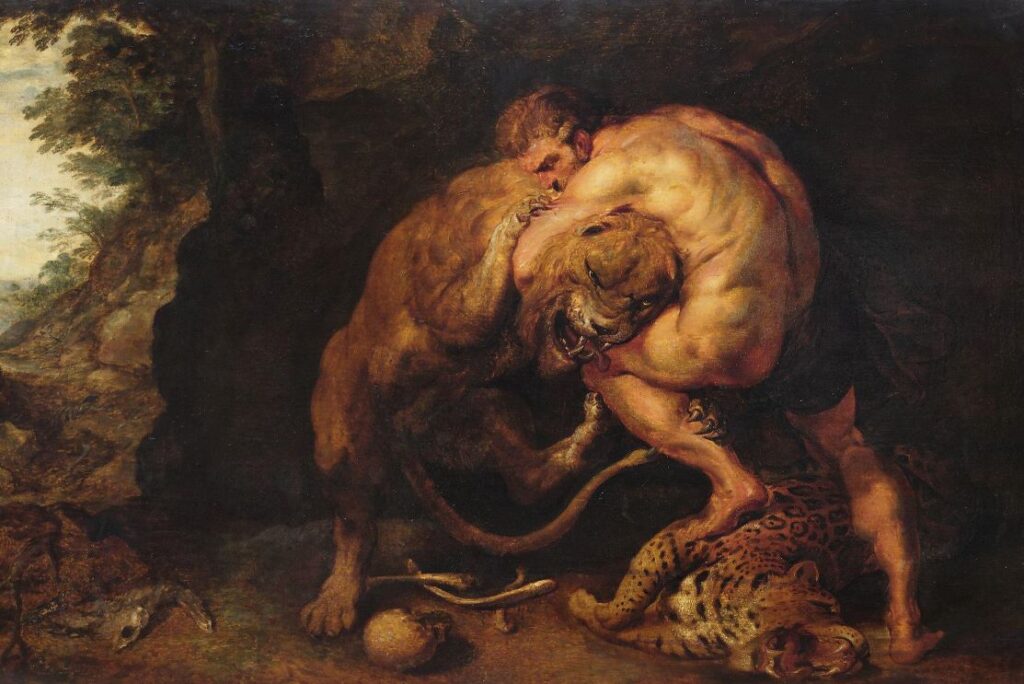
The first labour was to kill the Nemean lion, an invulnerable beast terrorizing the region of Nemea. After tracking down the infamous monster, Hercules fired several arrows at it, but he soon learned that its skin was impenetrable and that he could not harm it from afar. He thus threw away his weapons and approached the lion unarmed, chasing the lion back to its cave. Knowing that the beast was immune to his weapons, he then grasped the lion firmly around its neck and choked it to death. Ever since, Hercules wore the lion skin as a testament to his prowess. When he returned to Mycenae, Eurystheus was so terrified by Hercules’ achievement, that he forbade him to enter the city. He even had a bronze jar made in which he could hide whenever Hercules was around.
Second Labour: Hydra of Lerna
“As a second labour he ordered him to kill the Lernaean hydra. That creature, bred in the swamp of Lerna, used to go forth into the plain and ravage both the cattle and the country.”
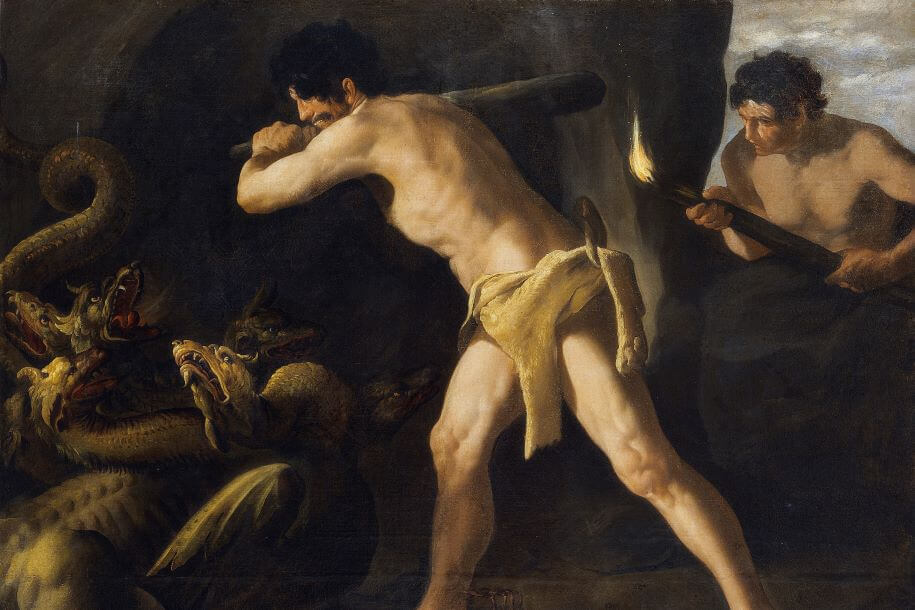
The second labour was to slay the Hydra of Lerna, a monstrous nine-headed serpent dwelling in the murky waters near Lerna. Once Hercules arrived at the swamps, he drew the monster out of its den with fiery arrows. He then proceeded to attack its many heads, but every time he had smashed one of them, two new ones emerged. Therefore, he called on his nephew Iolaus to help him. Whenever one of the Hydra’s heads was severed, Iolaus would burn the stumps with a torch so that no new ones could grow from it. Thus, Hercules was eventually able to defeat the Hydra of Lerna.
Third Labour: Ceryneian Hind
“As a third labour he ordered him to bring the Cerynitian hind alive to Mycenae. Now the hind was at Oenoe; it had golden horns and was sacred to Artemis.”
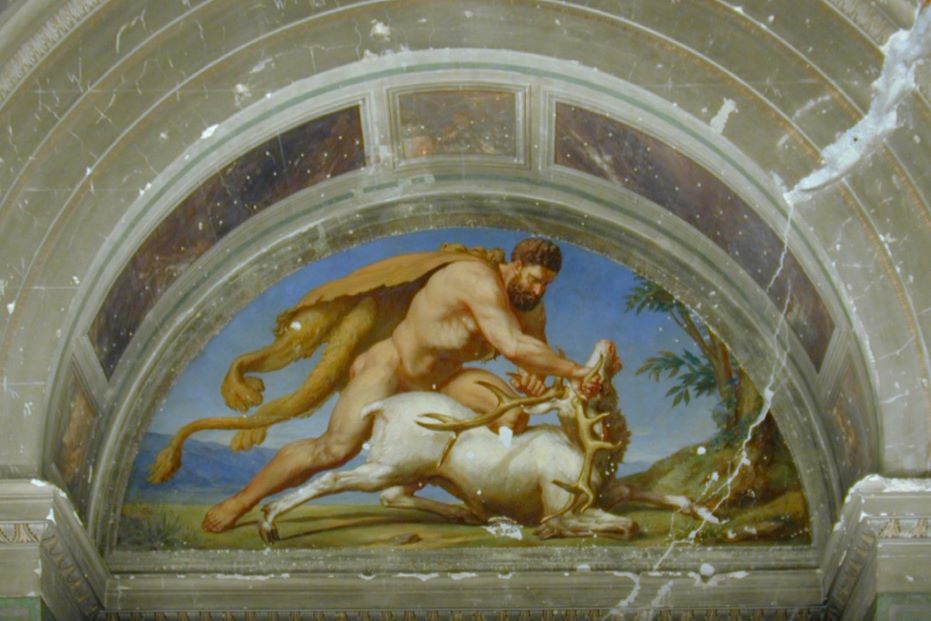
The third labour was to capture the Ceryneian Hind, a deer with golden horns that was sacred to Artemis, the goddess of the hunt. Because of its sacred status, Hercules could not kill the beast. Instead, he had to capture it and bring it back alive to king Eurystheus. Hercules chased the deer for an entire year, but he was finally able to capture it at the river Ladon, when it was weary of the chase. As Eurystheus had hoped, Hercules had angered Artemis by capturing her sacred deer. When he explained it was part of his labours, however, the goddess forgave him his crime.
Fourth Labour: Erymanthian Boar
As a fourth labour he ordered him to bring the Erymanthian boar alive; now that animal ravaged Psophis, sallying from a mountain which they call Erymanthus.
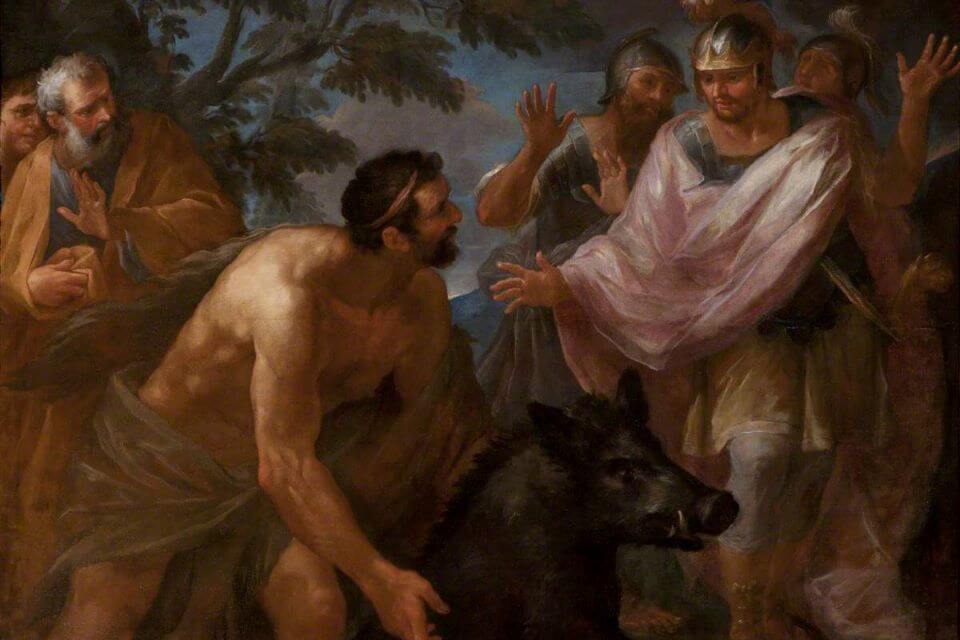
The fourth labour was to bring back the Erymanthian Boar, a fearsome beast living on Mount Erymanthus. Every day it would storm down from its lair to ravage the surrounding lands of Psophis. On his way to Mount Erymanthus, Hercules decided to visit his centaur friend Pholus, who happened to live nearby. Sharing a meal together, Hercules without permission opened a jar of wine that was a special gift of Dionysus. Drawn by the smell of their precious wine, the centaurs in the area quickly approached and attacked him for his crime.
“When Hercules called for wine, he said he feared to open the jar which belonged to the centaurs in common. But Hercules, bidding him be of good courage, opened it, and not long afterwards, scenting the smell, the centaurs arrived at the cave of Pholus, armed with rocks.”
Hercules used his poisoned arrows, which he had dipped in the Hydra’s venomous blood, to massacre the nearing centaurs. Even his friend Pholus died, for he accidentally touched an arrow when inspecting the corpse of another centaur. After burying his friend, Hercules continued his boar hunt. He frightened with shouts, chased it into the deep snow of the mountain, and trapped it in his net. After thus defeating the Erymanthian Boar, he brought it back alive to Eurystheus.
Fifth Labour: Augean Stables
“The fifth labour he laid on him was to carry out the dung of the cattle of Augeas in a single day.”
The fifth labour was to clean the stables of Augeas, the king of Elis, who famously owned more cattle than anyone else in the whole of Greece. Eurystheus believed that this task was not only humiliating but also be impossible to complete. Hercules, however, showed that there was more to him than just his strength. He diverted the course of two rivers nearby, the Alpheus and the Peneus, so that they would flow through the stables and take with them all the dung. And thus Hercules successfully cleaned the Aegean Stables in the matter of a day.

Sixth Labour: Stymphalian Birds
“The sixth labour he enjoined on him was to chase away the Stymphalian birds.“
The sixth labour was to drive away the flock of Stymphalian Birds, ferocious man-eating birds with beaks of bronze. When Hercules had tracked the birds down in a forest near Lake Stymphalia, for the first time he was clueless how to complete his task. Athena pitied the Greek hero and gave provided him with rattles that Hephaestus has made especially for this occasion. With these newly acquire rattle, Hercules was finally able to drive away the frightened Stymphalian Birds, shooting some of them to take with him as proof of his success.

Seventh Labour: Cretan Bull
“The seventh labour he enjoined on him was to bring the Cretan bull.“
The seventh labour was to capture the Cretan Bull, which was a wild beast that terrorized the island of Crete. The king of the island, Minos, had promised Poseidon he would offer whatever the god would send him from the sea. One time Poseidon sent a bull from the sea so beautiful that the king did not want to sacrifice it. Poseidon was so infuriated that he made the bull lay waste to whole the island. After sailing to Crete, Hercules tracked the bull down, wrestled it down to the ground, and took it with him to Eurystheus. And thus, Hercules completed his seventh labour.

Eighth Labour: Mares of Diomedes
“The eighth labour he enjoined on him was to bring the mares of Diomedes the Thracian to Mycenae.“
The eighth labour was to capture the Mares of Diomedes, which were terrifying man-eating creatures of Diomedes of Thrace, king of the Bistones. Hercules set out and arrived in Thrace with a ship full of companions. They went to the stables of Diomedes, overpowered the grooms, and took the mares with them. Though the theft had not gone unnoticed and the Bistones quickly chased pursued Hercules and his friends. To be able to fight, Hercules handed the mares over to the young companion Abderos. They subsequently killed Diomedes and won the fight, but when they returned to the shore, they noticed that the uncontrollable horses had killed Abderos. In some versions it is said that Hercules fed Diomedes to his horses as revenge. Thereafter, Hercules returned with the Mares of Diomedes to Eurystheus and thus completed his eighth labour.

Ninth Labour: Belt of Hippolyta
“The ninth labour he enjoined on Hercules was to bring the belt of Hippolyte. She was queen of the Amazons, who dwelt about the river Thermodon, a people great in war.”
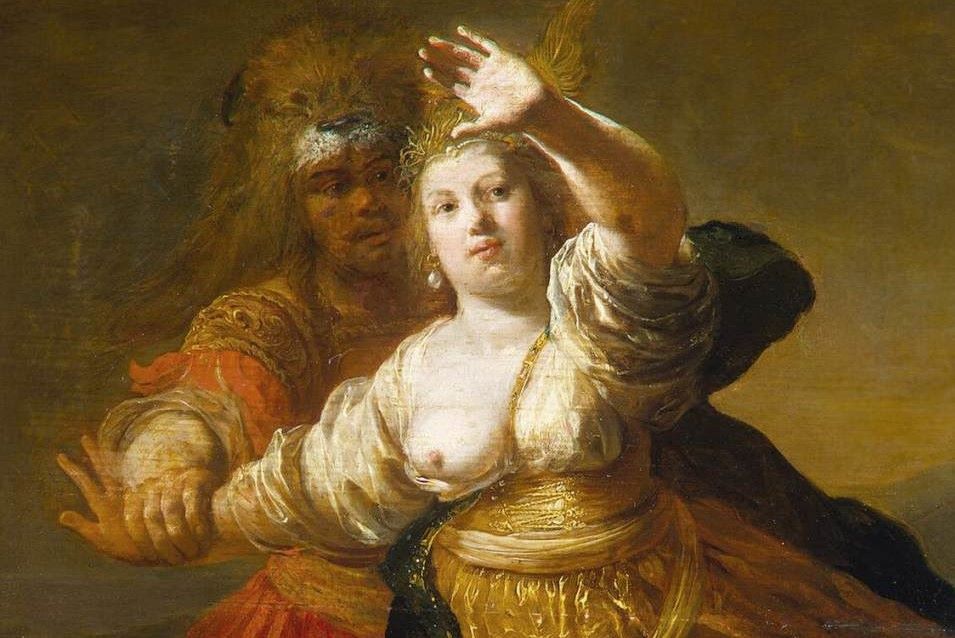
The ninth labour was to obtain the Belt of Hippolyta, who was the queen of the Amazons, a tribe of female warriors. Ares, the god of war, had given the belt to Hippolyta as an emblem of her superiority. Eurystheus commanded Hercules to fetch it, since his daughter Admete wanted it for herself. After a long journey, Hercules arrived at realm of the Amazons. Hippolyta came down to inquire why the visitors had come. When Hercules told her he came for her belt, she promised him to give it. But Hera did not like it. She subsequently disguised herself as an Amazon warrior and spread the false rumour that strangers were plotting to carry off their queen. Once Hercules noticed the alarmed Amazons were approaching quickly, he thought of treachery, killed Hippolyta, and took her belt. They quickly disembarked and returned to Eurystheus to hand over the girdle.
Tenth Labour: Cattle of Geryon
“As a tenth labour he was ordered to fetch the kine of Geryon from Erythia.”
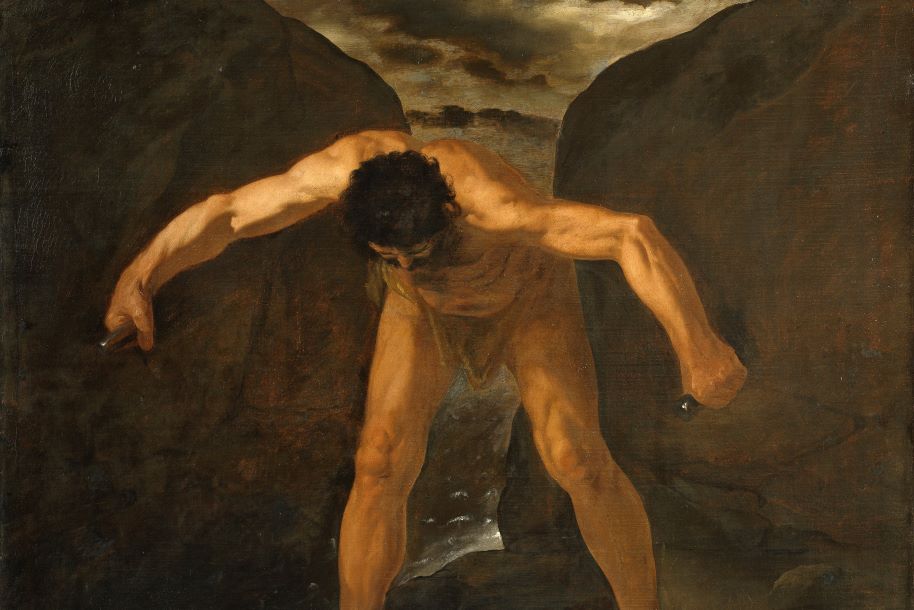
The tenth labour was to steal the cattle of Geryon, a three-headed monster who dwelled on the island of Erythia. On his way to Geryon, Hercules reached the utmost western point of his journey. There, he founded a monument to commemorate his long journey, known as the Pillars of Hercules. According to some versions, he split up the mountain range that connected the European mainland with Africa, thus creating what we now know as Strait of Gibraltar. The Pillars of Hercules today can still can be found on the national flag of Spain.
“So journeying through Europe to fetch the [cattle] of Geryon he destroyed many wild beasts and set foot in Libya, and proceeding to Tartessus he erected as tokens of his journey two pillars over against each other at the boundaries of Europe and Libya.”
When Hercules finally arrived at the island of Erythia, he first was confronted by Geryon’s two-headed watchdog Orthus, the little brother of Cerberus, and the shepherd Eurytion. After he had defeated them, he shot the approaching Geryon with one of his poisoned arrows. Taking the Cattle of Geryon with him, he went back to Eurystheus and at last completed his tenth labour.
Eleventh Labour: Apples of the Hesperides
“When the labours had been performed in eight years and a month, Eurystheus ordered Hercules, as an eleventh labour, to fetch golden apples from the Hesperides, for he did not acknowledge the labour of the cattle of Augeas nor that of the hydra.”
The eleventh labour was to steal the Apples of the Hesperides. These golden apples were kept in a garden at the edges of the world and guarded by the Hesperides, daughters of Atlas. Hercules did not know where the garden was, so he travelled long and far. One day he stumbled upon the titan Prometheus, who was chained to a rock as punishment for stealing the fire of the gods. Every day, a monstrous eagle would come down to eat out his liver. And every day it grew back, so that the process would be repeated on the next day. Hercules decided to kill the eagle and to free Prometheus from his torment. In gratitude, Prometheus told Hercules how to obtain the apples.
“Now Prometheus had told Hercules not to go himself after the apples but to send Atlas, first relieving him of the burden of the sphere.”
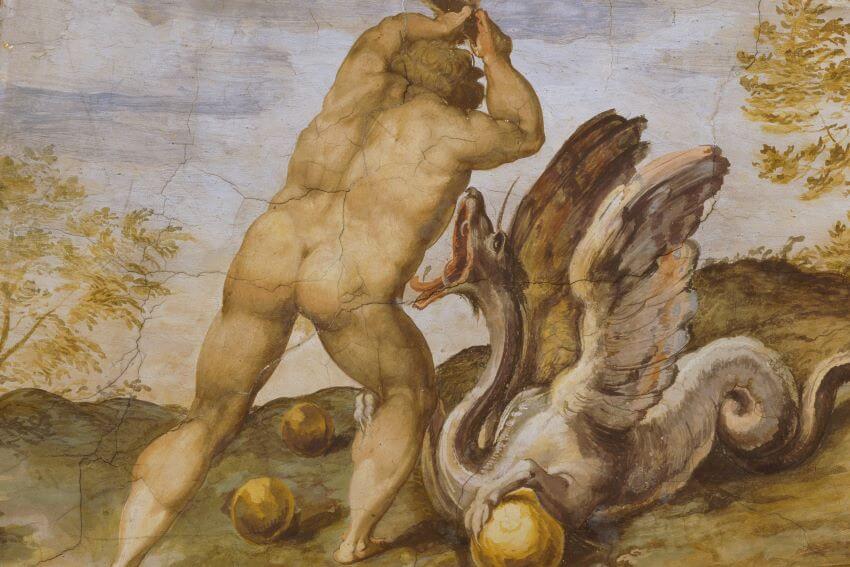
When Hercules was at last approaching the garden of the Hesperides, he encountered Atlas, the titan who held up the heavens on his shoulders. Hercules heeded Prometheus’ advice and relieved Atlas of his burden. Atlas in turn agreed to fetch the apples, but upon his return refused to take back the burden of the heavens. Hercules, however, tricked Atlas by saying he take the burden upon himself for eternity, but only on the condition that Atlas relieved him for just a minute so that he could adjust his cloak. Atlas fell for it and so Hercules could return safely with the apples. According to another version, Hercules fetched the apples himself after slaying the dragon Ladon.
Twelfth Labour: Cerberus
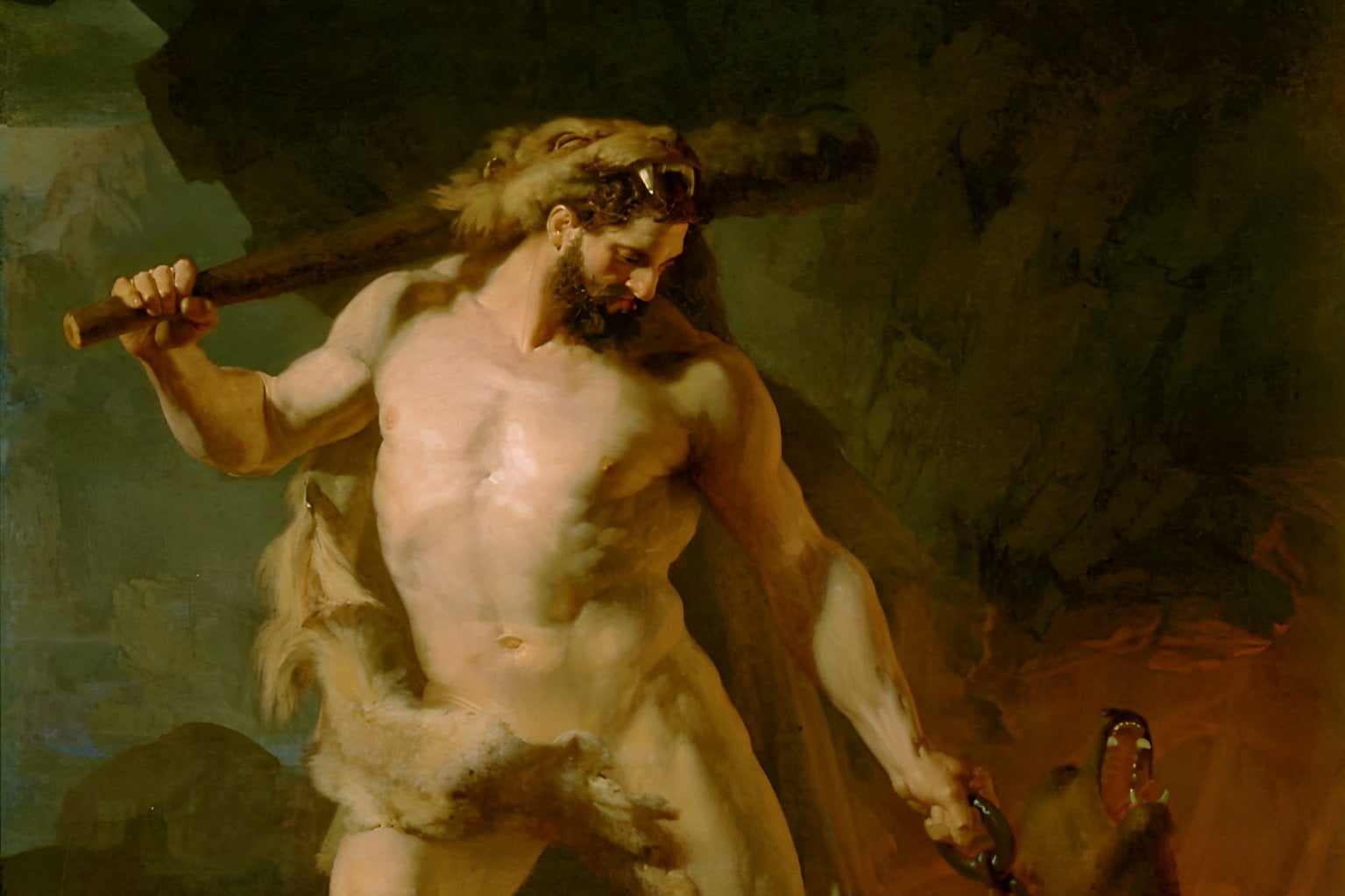
“A twelfth labour imposed on Hercules was to bring Cerberus from Hades. Now this Cerberus had three heads of dogs, the tail of a dragon, and on his back the heads of all sorts of snakes.”
The twelfth labour was to capture Cerberus, the three-headed hell-hound who guarded the gates the underworld. This labour was without a doubt the most dangerous one. To prepare for this terrific task, Hercules was initiated in the Eleusinian Mysteries. For the Greeks believed that, once initiated, one would have a better fate in the underworld. Helped by Hermes, Hercules made his way into the underworld and eventually found Hades, the god of the dead. When asked whether he could take Cerberus with him, Hades replied that he could do so, on the condition that he subdued Cerberus with his bare hands. Hercules agreed and wrestled it down into submission.
“Hercules found him at the gates of Acheron, and, cased in his cuirass and covered by the lion’s skin, he flung his arms round the head of the brute, and though the dragon in its tail bit him, he never relaxed his grip and pressure till it yielded.“
Holding him firmly in his grasp, Hercules returned to Eurystheus with Cerberus in his arms. The Mycenaean king was terribly frightened when he saw Hercules approaching with Cerberus. Fleeing again into his bronze jar, he begged Hercules to return the hell-hound to his master in the underworld, offering in turn to release Hercules at last. And so it was that Hercules brought back Cerberus to Hades and finally he was freed from his endless labours. He had atoned for his sins, but little did he know that his adventures were far from over.

Further Reading
The main source for this article was Pseudo-Apollodorus’ Bibliotheca 2.5 in the translation by Sir James George Frazer, available on Perseus Digital Library. Hercules also makes an appearance in Apollonius Rhodius’ Argonautica and in Ovid’s Metamorphoses IX, the latter of whom tells the story of Nessus and Deianira, and of Hercules’ death and transformation. As for Hercules’ reception, kings and emperors liked to assimilate themselves with Hercules, such as Alexander the Great and the Roman emperor Commodus.