Alcibiades (450-404 BC) is arguably one of the most controversial and fascinating figures in ancient history. The Athenian statesman and general, who was a student and alleged lover of Socrates, almost single-handedly brought Athens to the brink of destruction by instigating the Sicilian Expedition. However, Alcibiades would become most known for defecting not once but twice, first from Athens to Sparta, and then from Sparta to Persia.
Early Life
Alcibiades was born in 450 BC in Athens as the son of Cleinias, in the renowned family of the Alcmaeonidae, who according to tradition descended from Nestor. After his father died when Alcibiades was just three years old, he was placed under the guardianship of his uncle Pericles and he would grow up in his household. The statesman Pericles, who became the undisputed leader of democratic Athens, who established the Delian League in the early years of the Peloponnesian War, and who started ambitious building programs like that of the Parthenon, the shimmering temple of Athena on the acropolis, was too preoccupied with politics to give Alcibiades the attention he needed.

The absence of a father might have contributed to Alcibiades’s fickle personality. He was said to be an overconfident teenager of a changeable, unpredictable, and passionate nature. Above all, he always wanted to come out on top, one way or another, at least if we are to believe Plutarch’s account.
“Once, he was hard pressed at wrestling and was in danger of being thrown. In order to prevent this happening, he shifted the grip of the boy who was giving him a hard time to within reach of his mouth and was on the point of biting right through his arms. The other boy let go of him and said, ‘You bite like a woman, Alcibiades.’ ‘No, I don’t,’ Alcibiades replied. ‘I bite like a lion.'”
Plutarch, Alcibiades 2 (trans. Robin Waterfield)
It was said of him that he was one of the most beautiful men in the whole of Greece. Alcibiades knew this very well and he made good use of it. It gave him an irresistible charm and it made him popular with men and women alike.
“As for Alcibiades’ looks, all that needs to be said is that it bloomed in his childhood, in his youth, and when he was grown up too; however old he was and whatever phase of physical growth he was at, the attractiveness and charm afforded him by his good looks never left him. Euripides’ notion that anyone beautiful remains beautiful in their autumn is not universally true, but Alcibiades is one of the people to whom it does apply, for his natural beauty and physical perfection.”
Plutarch, Alcibiades 1 (trans. Robin Waterfield)
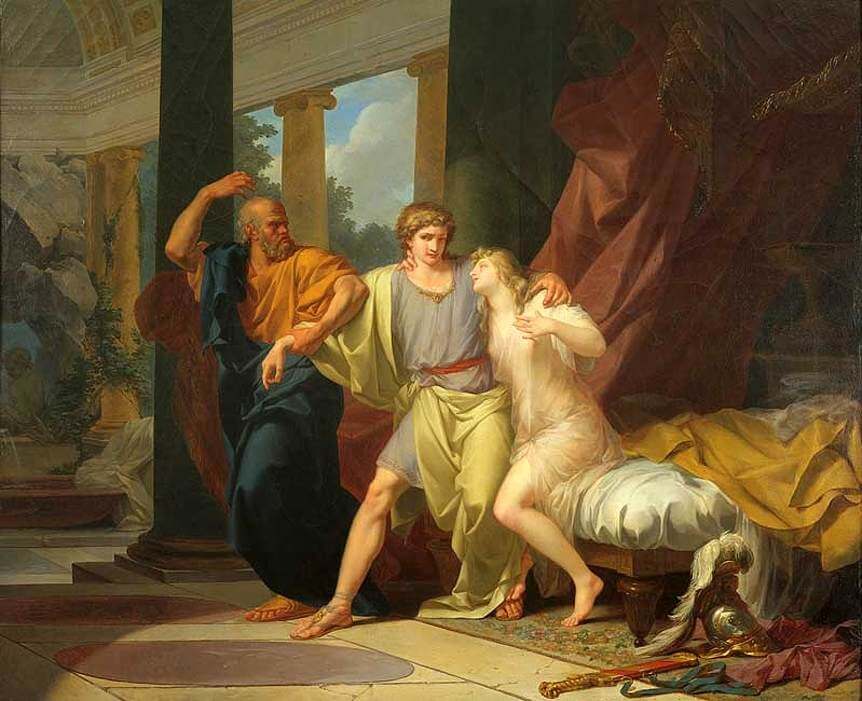
Even Socrates, the great philosopher, could not resist his looks, allegedly becoming Alcibiades’ lover. Trying to keep Alcibiades, who indulged in vain ambition and sensual pleasure, on the path of virtue, Socrates took upon himself Alcibiades’ philosophical and moral education, as he thought it a shame to let his talents go to waste.
“Socrates saw Alcibiades’ physical good looks as the brilliant external manifestation of this excellence, and he worried about the boy’s wealth and social standing, about that fact that masses of people from Athens and from both allied and other cities abroad were employing flattery and favouritism to pre-empt his affections. So Socrates set out to protect him against these influences; he could not just stand by and watch a blossoming tree wastefully destroy its own fruit.”
Plutarch, Alcibiades 4 (trans. Robin Waterfield)
Rise to Power
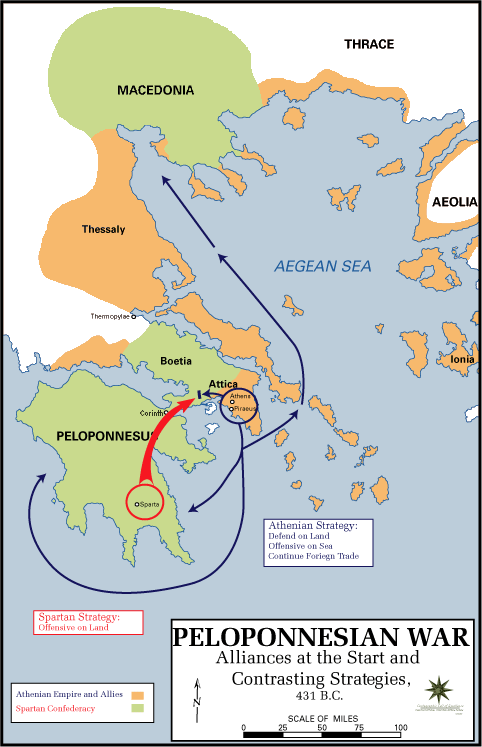
When Alcibiades was around twenty years old, the Peloponnesian War (431-404 BC) between Athens and Sparta erupted. The conflict between both city states and their allies, the Delian League and the Peloponnesian League, would last for almost thirty years, due to a balance in economic and military strength. Athens had a superior navy and in large part had control over the Aegean sea and its city states, including the Cyclades, southern Thrace, and western Anatolia. It enabled them to receive tribute from their vassal states, which were part of the Delian League, and to trade freely overseas. The Spartans, however, were superior on land. With their unequalled hoplite army, they controlled the Peloponnese and its city states, with which they formed the Peloponnesian League. The Spartans regularly invaded the province of Attica, but they were unable to conquer Athens.
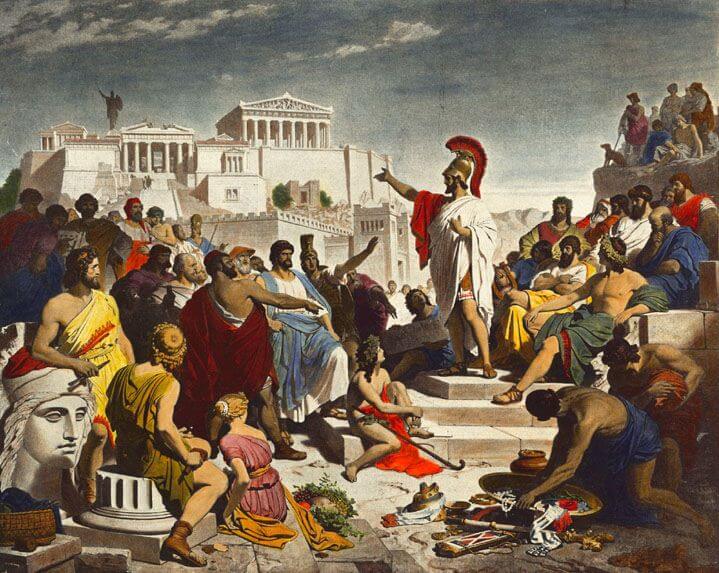
It was in this historical context that Alcibiades rose to power, more specifically when Athens and Sparta had negotiated a peace treaty in 421 BC. Alcibiades heavily despised Nicias, who was then in power and had negotiated this peace treaty. In order to set himself apart, Alcibiades expressed his strong opposition to any sort of agreement with Sparta. Rather, he argued that an alliance with Argos could benefit Athens. However, if we are to believe the Athenian historian Thucydides, Alcibiades acted just as much in self-interest as in the interest of the state.
“With relations between Athens and Sparta now come to this state of rupture, those in Athens too who wanted to abandon the peace-treaty were quick to press their case. Prominent among these was Alcibiades the son of Cleinias, still of an age which would be thought young in any other city, but respected for the distinction of his family. He did actually believe that greater advantage lay in an accommodation with Argos, but there was also an element of piqued pride in his opposition to the Spartan treaty, in that the Spartans had negotiated the peace through Nicias and Laches, ignoring his own claim because of his youth and showing no regard for what had been a long family tradition of service as consular representatives for Sparta.”
Thucyidies, History of the Peloponnesian War 5.43 (trans. Martin Hammond)
The Sicilian Expedition
With his unequalled charm and cunning Alcibiades was able to deceive the Spartan delegation of diplomats and to thwart any peace treaty with Sparta. He convinced the Athenian people to form an alliance with Argos and he was subsequently appointed general. The Athenian democracy had always been susceptible to demagogues, who pretended to speak on behalf of the people, and Alcibiades made full use of it. He would have done anything to come to power, and now he actually has. But still, he was not satisfied. When the Sicilian city of Segesta asked Athens for their support in their war against Silenus, Alcibiades opportunistically saw this as another means to expand his power. He stirred the people’s imagination by promising them a golden future for Athens, while slandering Nicias for his overly cautious approach.
“A campaign there will increase our power here, and we should sail. (…) Do not let Nicias deflect your purpose with his quietist talk and his attempt to create a division between young and old.”
Thucydides, History of the Peloponnesian War 6.18 (trans. Martin Hammond)
Little did Alcibiades know what he had set in motion. The Sicilian Expedition would end in an absolute catastrophe and he himself would be sentenced to death by the Athenian people. After he had set sail for Sicily, Alcibiades’s political opponents conspired against him and fabricated the charge that he had profaned the gods by mutilating Athens’ sacred hermai sculptures – which were indeed vandalized – and ridiculing the Eleusinian Mysteries. Despite Socrates’s attempts to rein him in, Alcibiades was too hungry for glory, power, and wealth to follow the path of reason. For all his virtues, he had just as many vices, and it is likely this was in part the cause of his downfall.
“But along with his statesmanship, eloquence, pride, and ingenuity went, by contrast, a luxurious lifestyle, over-indulgence in drink and sex, effeminacy of dress – he would trail his purple-dyed clothing through the city square – and incredible extravagance. (…) The Noble men of Athens combined feelings of abhorrence and disgust with fear of his haughty and lawless attitude, which struck them as tyrannical in its excessiveness. As for the common people, their feelings towards him have been well summed up by Aristophanes in the following line: ‘They miss him, hate him, want him to be with them.'”
Plutarch, Alcibiades 16 (trans. Robin Waterfield)
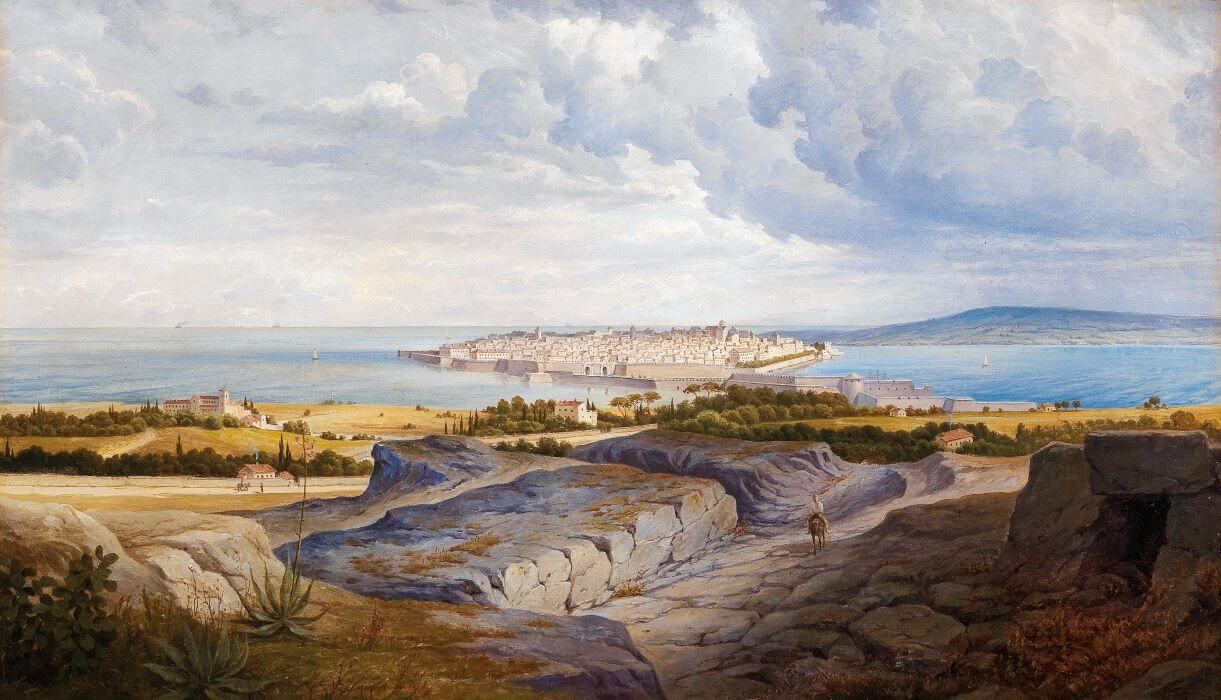
Before he had truly set foot ashore in Sicily, an arrest warrant was issued to seize Alcibiades and bring him back to Athens. Although the expedition, now under the control of Nicias, failed disastrously, it no longer mattered for Alcibiades, for he had fallen out of favour with the Athenians. He fled before he could be arrested.
Defecting to the Enemy
Of all places, Alcibiades defected to Sparta. Even though it was Athens’s archenemy in the Peloponnesian War, Alcibiades knew that least he would be safe there from the Athenians. So he quickly made his way to the Peloponnese and contacted the Spartans, opportunistically asking for asylum in exchange for valuable information about Athens that could help them to get an edge in the war. After he was granted this request, Alcibiades had to adapt to his new surroundings and he had to prove his worth again, though he was surprisingly good at this, like a chameleon.
“The point is that, of the many skills Alcibiades possessed, we hear in particular of one which was a useful tool for captivating men, and that was that he could assimilate and adapt himself to their habits and lifestyles. He could change more abruptly than a chameleon. (…) In Sparta he took exercise, lived frugally, and wore a frown on his face; in Ionia he was fastidious, companionable, and easy-living; in Thrace he went in for hard drinking and hard riding; when he was with the satrap he outdid the Persians, for all their magnificence, his pomp and extravagance.”
Plutarch, Alcibiades 23 (trans. Robin Waterfield)
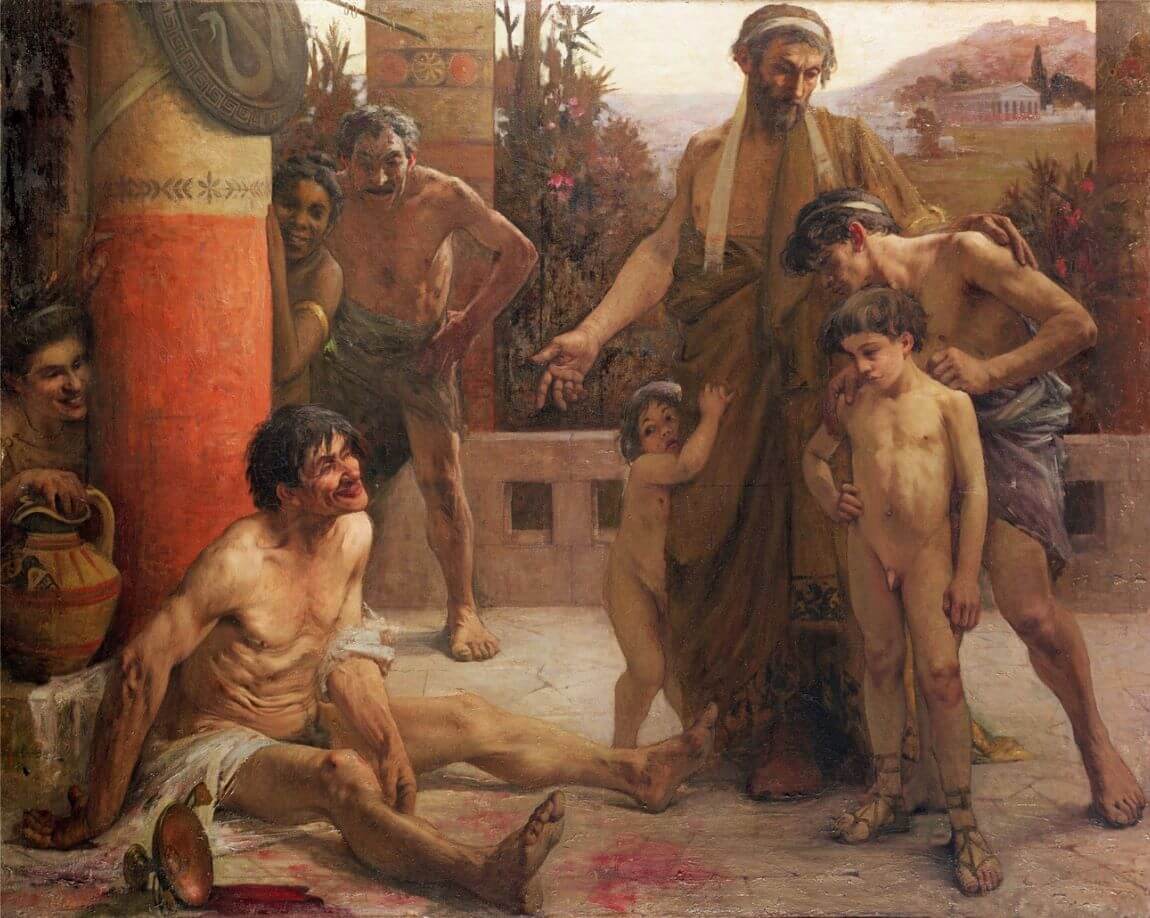
Despite his ability to adapt to the Spartan way of living, and despite his valuable contributions in the war against Athens, Alcibiades eventually fell out of favour with the Spartans – as if his charms here too had finally worn off. Furthermore, the story goes that Alcibiades had seduced the Spartan king’s wife, Timaea. When the rumour spread through all of Sparta that the queen was pregnant with his child, it again was time for Alcibiades to go on the run. This time around, he took refuge with another unlikely ally, the Persian satrap Tissaphernes, governor of the provinces of Lydia and Ionia. Like the Athenians and Spartans, he too could not resist Alcibiades’ charms
“Before long there was no one Tissaphernes admired or valued more. The Persian was a devious and malicious man, who felt no qualms about doing wrong, and he was impressed by Alcibiades’ versatility and extraordinary ingenuity. No one, whatever his character or temperament, could fail to be touched and captivated by Alcibiades’ charisma.”
Plutarch, Alcibiades 24 (trans. Robin Waterfield)
Making use of newly acquired position at the Persian court, Alcibiades began to negotiate with Athens – undoubtedly just as much motivated by opportunism as patriotism. In any case, he convinced the Athenian fleet at Samos that the only way for way for them to defeat Sparta was to form an alliance with Persia. And he just happened to be the middleman to arrange it. When he was made general of the Athenian fleet at Samos, however, he was arrested and imprisoned by Tissaphernes. Miraculously enough, Alcibiades was able to escape and quickly he quickly resumed command of the Athenian navy. After leading the fleet to a spectacular victory over the Spartans at Cyzicus, in the Sea of Marmara, Alcibiades had a strong desire to see his fellow citizens again and so he set sail for Athens.

Finally someone had given the Athenians a much needed victory over the Spartans. His property was restored, the charges against him were dropped, and he was appointed military command with full power on land and sea. In short, Alcibiades returned to Athens in triumph. Upon his arrival, the docks of Piraeus were crowded with people and Alcibiades was hailed as a true hero to Sparta, as if he had never left.
“[The people] ran and crowded round him, calling out to him, greeting him, accompanying him on his way, and crowning him with garlands if they could get close to him,. while those who could no watched him from a distance, and the older men pointed him out to the younger ones. But the city also found the occasion a bitter-sweet mixture of tears and smiles, as people remembered and compared their present good fortune with their former misfortunes, and reflected that they would not have failed in Sicily, nor would any of their other hopes have been dashed, if only they had left Alcibiades in charge of their affairs at the time, and in command of that expeditionary force.”
Plutarch, Alcibiades 32 (trans. Robin Waterfield)
Death and Legacy
After his triumphant return, thing would go downhill for Alcibiades. Losing a major naval battle with Sparta, Alcibiades was blamed for negligence and he again – this time definitively – fell out of favour with the Athenian people. He condemned himself to exile, fleeing first to Thrace and later to Phrygia, taking refuge with the Persian satrap Pharnabazus. But even there, he was not safe, for the enemies he had made during his life were everywhere. It is said that Alcibiades met his end in 404 BC, killed in his humble dwelling in Phrygia, likely at the hands of Spartan assassins sent by Lysander, who feared that Alcibiades might once again return to rescue Athens.
“The men sent to kill him did not dare to enter the house, but surrounded it and set it on fire. When Alcibiades noticed the fire, (…) he dashed out of the house before the clothing caught fire. He was unharmed by the fire, and when the foreign assassins saw him they scattered. Not one of them stood his ground against him or came up to fight him hand to hand; they kept their distance and hurled javelins and fired arrows at him instead. So this is how he met is death.”
Plutarch, Alcibiades 39 (trans. Robin Waterfield)
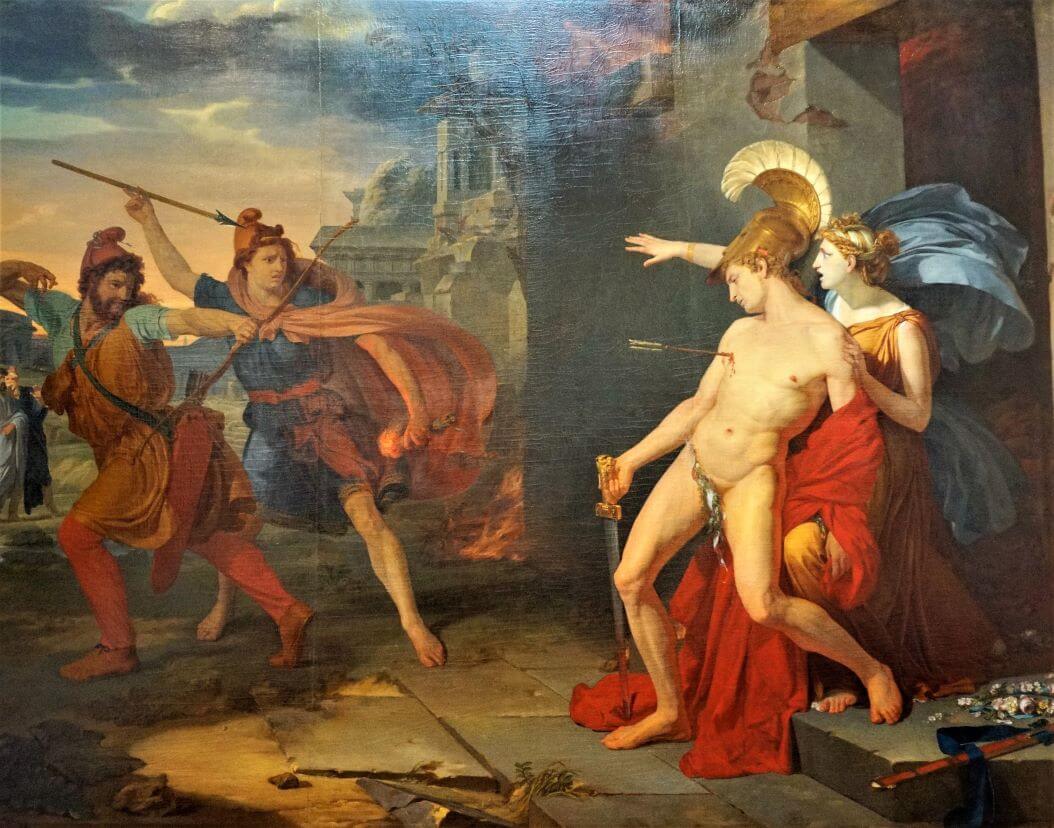
Even after he had taken his final refuge in the remote Phrygia, even when a return to Athens was out of the question, even after he had betrayed and disappointed his city, the people still dreamed about the return of their hero Alcibiades.
“Yet even in these circumstances some faint hope was reviving that all was not quite lost for the city as long as Alcibiades remained alive.”
Plutarch, Alcibiades 38 (trans. Robin Waterfield)
Even though Alcibiades had made enemies everywhere throughout his life, his name continued to instill awe and wonder in the hearts of men. Alcibiades, son of Cleinias, the most beautiful man in the whole of Hellas, to this day is still able to spark our imagination.
Further Reading

I was inspired to write this article on Alcibiades after reading the wonderful novel Alkibiades by the Dutch novelist and poet Ilja Leonard Pfeijffer. If you are Dutch or if there is a translation available, I would heartily recommend you to give it a try. However, the life of Alcibiades is fascinating enough in itself, so you do not need a novel to enjoy it. As for the primary sources, I would recommend you to read Plutarch’s Alcibiades, Thucydides’ History of the Peloponnesian War, Plato’s Alcibiades, or the earlier books of Xenophon’s Hellenica.