(Wikimedia Commons)
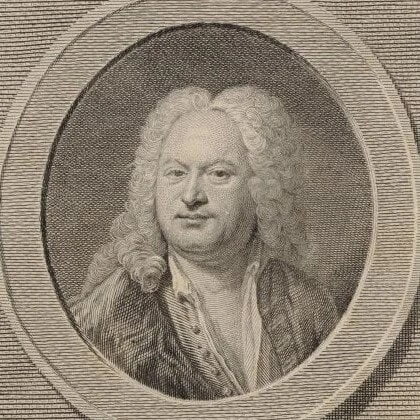
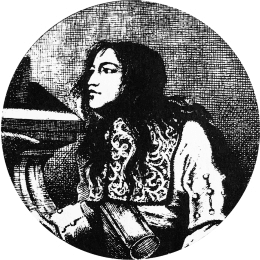
Sylvius Leopold Weiss (1687-1750) was a German composer and lutenist. Although largely overshadowed by renaissance lute composers like John Dowland, Weiss was known as the most prolific and successful lutenist of his age. He composed during the late Baroque Period, being almost an exact contemporary of Johann Sebastian Bach (1685-1750). It is mostly due to this fact that he now has largely been forgotten. The musician and academic Tim Crawford summarized it as follows.
“Silvius Leopold Weiss is just beginning to be recognised as one of the most important German composers of the first half of the eighteenth century. The delay is perfectly understandable: a composer whose oeuvre is confined to a single genre, solo lute music, is bound to be thought of as interesting to specialists only. Yet in his day this lutenist, an exact contemporary of J.S. Bach, was regarded with awe similar to that accorded to the great Leipzig organist by listeners and fellow-composers alike. The two were even compared by contemporary writers, especially for their legendary skill in improvisation, and Weiss was honoured as the highest-paid instrumentalist in (…) Dresden, and lived there in comfort and security. As far as posterity is concerned, Weiss’s principal misfortune is to find himself in the company of a figure now universally acclaimed as perhaps the greatest of all composers.”
Tim Crawford, from the booklet of Robert Barto’s recording ‘Weiss: Sonatas for Lute, Vol. 3‘
It is a shame that many people today are not acquainted with Weiss’s oeuvre. Lute music has generally been neglected in the history of western classical music. People indulge in pompous symphonies or peaceful piano sonatas, but they do not know the clarity, warmth, and grace that accompanies the sonorous sound of the lute.

Life and Works
Sylvius Leopold Weiss was born in 1687 in Grottkau, in modern day Poland. His father, Johann Jacob Weiss, who was said to be “a profound musician, lute and theorbo-player”, taught Sylvius and his siblings to play the lute. When he was around twenty years old, Weiss began to serve as a musician at various courts. Accompanying his patrons, he got the opportunity to see large parts of Europe and to hear various styles of music. In the following Overture, for example, he imitates the orchestral style of the French court.

Between 1710-1714, Weiss served the exiled Polish prince Aleksander Sobieski, whose court resided in the Palazzo Zuccari in Rome. In this new environment, acquainting himself with the Italian style, Weiss is likely to have met many Italian composers such as father and son Scarlatti. The Presto of his Sonata in B Flat Major, a concerto movement in the style of Arcangelo Corelli, is an example of this Italian influence. It is a display of his skill both as a player and a composer. The German lutenist Ernst Gottlieb Baron wrote that Weiss “was the first to have shown that one could do more on the lute than anyone could image.”
When his patron died, Weiss left Italy. In Prague, he met the famous Bohemian aristocrat, composer, and lutenist Jan Antonín Losy, whose music seems to have strongly influenced Weiss’ own compositions. At the least, the two must have been good friends. After Count Losy’s death, the twenty-four-year-old Sylvius would write a memorial tombeau in his memory, which remains one of his most introspective and eloquent compositions.

Around 1718, Weiss would grow weary of wandering and thus decided to settle down in Dresden, where he was appointed as a chamber musician at the court of Prince Elector of Saxony August the Strong. Dresden was then a flourishing city that could boast a rich tradition in the arts and sciences. It would remain Weiss’s home for the rest of his life. In the cultural scene of Dresden, with the finest opera houses and concert halls of its day, Weiss met many fellow composers and musicians, such as Pisendel, Quantz, and Benda.

In 1739, when he was fifty-two, Weiss even got to meet the Thomaskantor and organ virtuoso Johann Sebastian Bach, visiting him at his home in Leipzig. If we are to believe the following account of the composer and writer Johann Friedrich Reichardt, the two baroque composers were said to have competed in improvisation.
“Anyone who knows how difficult it is to play harmonic modulations and good counterpoint on the lute will be surprised and full of disbelief to hear from eyewitnesses that Weiss, the great lutenist, challenged J. S. Bach, the great harpsichordist and organist, at playing fantasies and fugues.”
Johann Friedrich Reichardt
As for lute compositions, Weiss was not inferior to Bach, and in him he might finally have found his equal. If we listen to the next reconstructed sonata by Weiss, remarkably written for two lutes rather than one, it is almost as if we hear Weiss and Bach together. Just imagine them sitting there, leisurely taking turns at playing, enjoying themselves till the late evening hours, and the family joining in to listen – the world in perfect harmony.
Further Listening
If you want to listen to more music by Weiss and other baroque composers, I can heartily recommend the following performers: Robert Barto (Naxos), Jakob Lindberg (BIS), Thomas Dunford (Erato), Hopkinson Smith (Naïve), and José Miguel Moreno (Glossa).